



ADGM business risk assessment (ADGM BRA): what FSRA and the Registration Authority expect, and how to run it
Published On: 11/24/2026
Protect your business with reliable and effective AML strategies with AML UAE.
Last Reviewed On: 11/24/2026 | Last Updated On: 11/24/2026
The ADGM AML Rulebook requires a business risk assessment, in chapter 6, from Authorised Persons (other than Credit Rating Agencies), Recognised Bodies, Representative Offices and DNFBPs. DNFBPs are fully covered: rule 1.2.1 applies chapters 1 to 9 and 11 to 15 to them.
UAE federal law adds the same duty on top, for financial institutions, DNFBPs and virtual asset service providers. In practice that means a bank, a payments or virtual asset firm, an accountant and a company service provider each need to assess the money laundering, terrorist financing and proliferation financing risks of their own business, write the assessment down, get senior management to approve it and keep it current.
This AML UAE guide explains what is required, what the FSRA and the Registration Authority have found going wrong, and what to keep on file so you can show your work.
In a nutshell. A business risk assessment (BRA), also called a business-wide or enterprise-wide risk assessment, is a binding duty under the ADGM AML Rulebook for Authorised Persons (other than Credit Rating Agencies), Recognised Bodies, Representative Offices and DNFBPs. Federal law adds the same duty across the UAE. It must cover customers, countries, products, delivery channels and technology, treat sanctions, terrorist financing and proliferation financing as part of the picture, be approved by senior management and be reviewed at least once a year and whenever something material changes. Firms should also set a risk appetite and embed the assessment in daily controls. AML UAE’s business risk assessment service builds and documents it.
Key takeaways
- The ADGM AML Rulebook applies to Authorised Persons (other than Credit Rating Agencies), Recognised Bodies, DNFBPs and Representative Offices, and its business risk assessment chapter (chapter 6) covers all of them. Its guidance also expects the assessment to cover fraud, theft of personal data and cyber security risk.
- Federal law sits above the ADGM rules and sets the same duty for every financial institution, DNFBP and virtual asset provider in the UAE.
- Since April 2026 the FSRA has published guidance on how it expects the assessment to be built and documented.
- Regulators keep finding the same gaps: generic ratings, sanctions risk missing, no approval or version record, and assessments that are out of date.
- In our own work, rebuilding a templated assessment from the firm’s data, with tested controls and a recorded approval, gave every finding a fix and a result.
- A risk appetite statement turns BRA ratings into decisions on controls. The ADGM rulebook does not use the term, but the Registration Authority treats an approved appetite linked to the assessment as good practice.
- An assessment only works if it is operationalised: owners, one-page reporting, staff briefings, links to onboarding and a review calendar.
- Keep one evidence file a reviewer can open and follow. The evidence file section below lists what goes in it.
The duty at a glance
| What you must do | When | Where it comes from |
|---|---|---|
| Identify, assess and document your risks, and give the study to the supervisor on request | Before you start, then continuously | Federal law, and ADGM AML Rulebook chapter 6 |
| Cover customers, countries, products, channels, transactions, new technology and the national risk assessment | In every assessment | ADGM AML Rulebook chapter 6 |
| Treat sanctions, terrorist financing and proliferation financing as part of the risk | In every assessment | ADGM AML Rulebook chapter 6 |
| Have senior management approve it | Each version | ADGM AML Rulebook chapter 6 |
| Review it and keep it up to date | At least yearly, and on triggers | ADGM AML Rulebook, FSRA guidance |
| Assess before launching anything new | Before launch | Federal law, and ADGM AML Rulebook chapter 6 |
| Produce it and show how you used it | Immediately, on request | ADGM AML Rulebook |
The five questions, answered
The table answers what, why, who, when and how in one line each, with a link to the section that explains it.
| Question | Short answer | Where to read more |
|---|---|---|
| What | A written, evidence-based assessment of the money laundering, terrorist financing, proliferation financing and sanctions risks your whole business faces, and of the risk left after your controls | Federal law, ADGM AML Rulebook |
| Why | The law and the ADGM AML Rulebook require it. It also tells you where to spend controls and gives senior management a view of exposure | Federal law, ADGM AML Rulebook, FSRA guidance, regulator findings, risk appetite |
| Who | Senior management approves it. The MLRO or compliance lead runs it. Each business line supplies the data | How to build, operationalise, approval and evidence |
| When | Before you launch anything new, whenever something material changes, and at least once a year | When must you update |
| How | Six steps: method, risks by factor, controls, residual risk, a separate sanctions component, then use it. A 30-day plan is in the build section, with risk appetite and embedding in the two sections that follow | How to build, risk appetite, operationalise |
Who needs an ADGM business risk assessment?
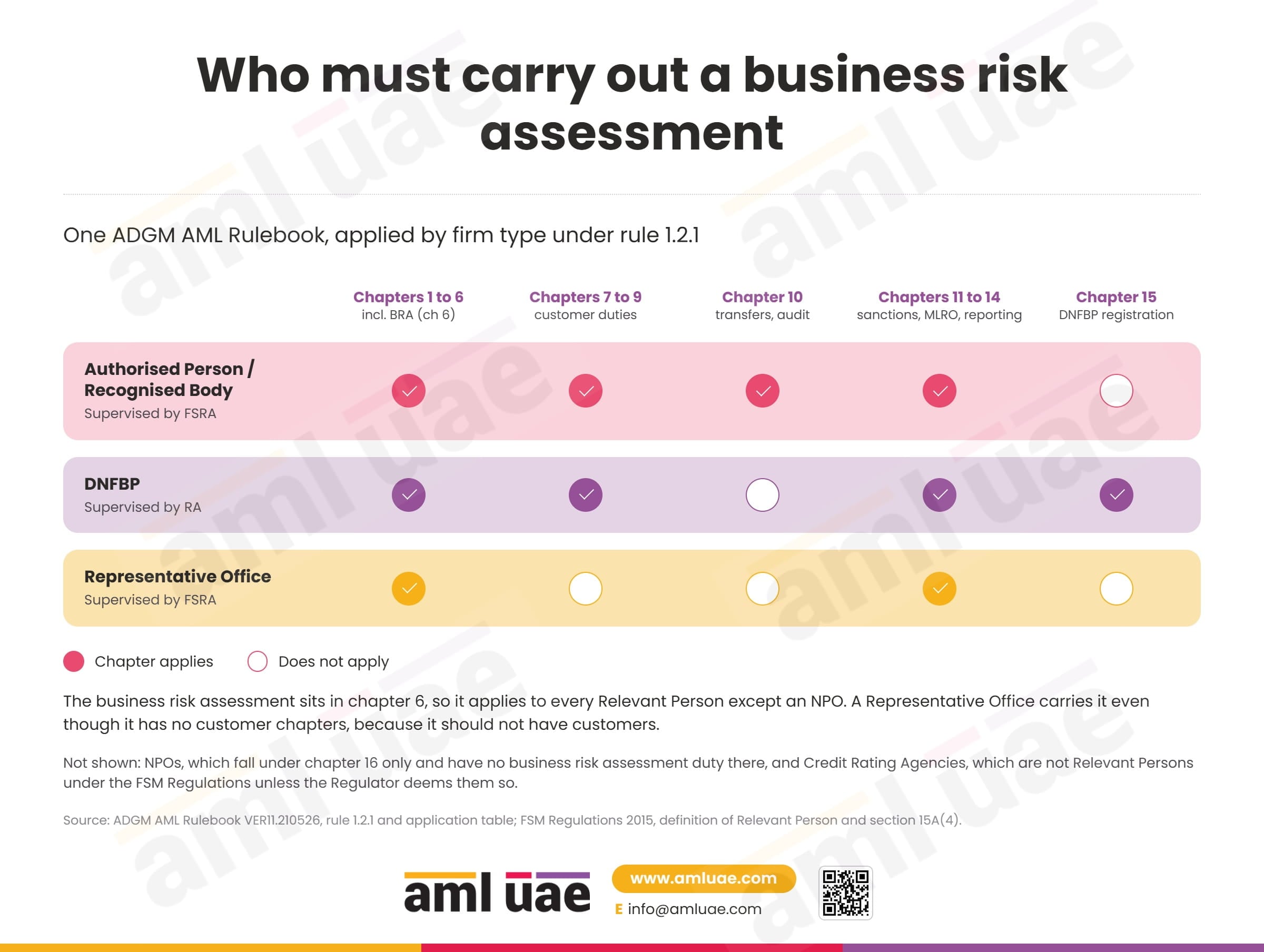
The ADGM AML Rulebook requires a business risk assessment from Authorised Persons (other than Credit Rating Agencies), Recognised Bodies, Representative Offices and DNFBPs. DNFBPs are fully covered. UAE federal law adds the same duty on top, for financial institutions, DNFBPs and virtual asset service providers.
The business risk assessment is also called a business-wide or enterprise-wide risk assessment. ADGM has one AML Rulebook, and chapter 6 on the business risk assessment applies to each of the groups named above. For the wider picture, read our AML guide for ADGM companies.
Status : binding requirement.
Banks, payment firms, virtual asset firms and other Authorised Persons
These are supervised by the FSRA, along with Recognised Bodies. The assessment is one part of a wider set of duties that includes customer due diligence, sanctions, reporting and, for these firms only, an ADGM internal audit rule.
DNFBPs
Company service providers, auditors, accountants, dealers in precious metals and stones and real estate agencies are supervised for AML by the Registration Authority (RA), which acts under a delegation from the FSRA.
Law firms are different. The ADGM Registration Authority licenses legal services firms and supervises compliance with their licence conditions, but federal AML supervision of Legal Professionals is a separate matter: the UAE Ministry of Justice may delegate some of its powers to the FSRA or the Registrar of Companies, and we have not verified an active delegation for legal professionals, so confirm with your supervisor.
The RA follows the same FSRA rulebook. It also issues guidance for DNFBPs, such as its BRA quick guide and its findings reports. Where this guide cites the RA, it reads the same rules with a DNFBP lens.
Representative Offices
The duty applies, although the customer chapters do not, because a Representative Office should not have customers.
Who does not need it?
Under rule 1.2.1(2)(d), non-profit organisations (NPOs) are subject to chapter 16 only, so chapter 6 does not apply to them. Credit Rating Agencies fall outside the Authorised Person limb of the Relevant Person definition in the FSM Regulations unless the FSRA deems them Relevant Persons under section 15A(4), so chapter 6 does not apply to them by default. Both are chapter 6 exclusions only. Federal AML law is a separate question, and the federal penalties provision names NPOs among the entities it covers.
What is a business risk assessment, and how is it different from a customer risk assessment?
A business risk assessment looks at the risk your whole business is exposed to. A customer risk assessment rates one customer. The first feeds the second. In practice firms also call the business-level exercise a business-wide or enterprise-wide risk assessment (EWRA), while the ADGM rulebook uses the term business risk assessment.
| Term | What it covers | About | How it connects |
|---|---|---|---|
| Business risk assessment (BRA) | Customers, countries, products, channels, transactions, technology and the risk left after controls | The whole firm | Required by chapter 6 of the ADGM AML Rulebook and by federal law |
| Customer risk assessment (CRA) | One customer's risk rating and the due diligence it triggers | One customer | Fed by the BRA |
| National and sector risk assessments | Risk across the UAE or a sector | A country or sector | An input to your BRA |
| Review of control effectiveness | Whether your policies and controls work | Your controls | Done at least yearly and takes the BRA into account |
What does UAE federal law require for the ADGM business risk assessment?
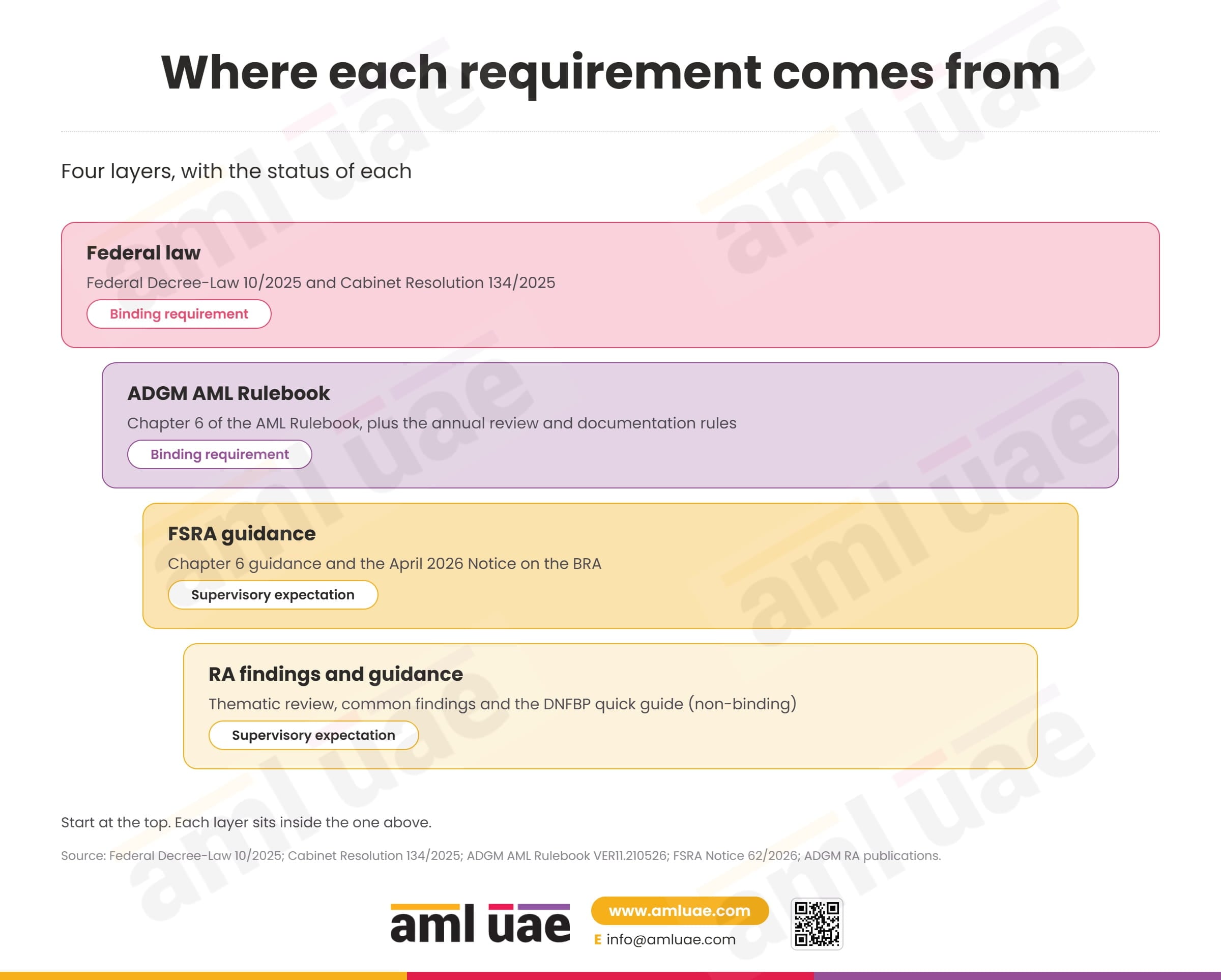
Federal law applies alongside the ADGM AML Rulebook. Federal Decree-Law 10/2025 and Cabinet Resolution 134/2025 require financial institutions, DNFBPs and virtual asset providers to identify, assess, document and update their crime risks, keep the study and give it to the supervisor on request. The ADGM rules cannot lower that duty.
Status : binding requirement.
Which AML law applies in ADGM?
Two layers apply, and you need both. The federal Decree-Law and its Cabinet Resolution apply across the UAE. The ADGM AML Rulebook, issued by the FSRA, applies to firms in or from ADGM and adds detail. Zone rules cannot lower a federal duty, so where the two differ, apply the stricter standard (our practice).
What must the business risk assessment include?
You must weigh customer, country, product, service, transaction and delivery channel risk, take the national risk assessment into account, and set controls in proportion to the risk. You must also assess the risk before launching a new product, practice or technology, have policies approved by senior management and have an independent audit function test them.
What are the penalties?
Under FDL 10/2025, Article 17(1), a supervisor can impose a fine of AED 10,000 to AED 5,000,000 for each violation. It can also suspend or restrict the activity or profession and revoke the licence.
What does the ADGM AML Rulebook require for the ADGM business risk assessment?
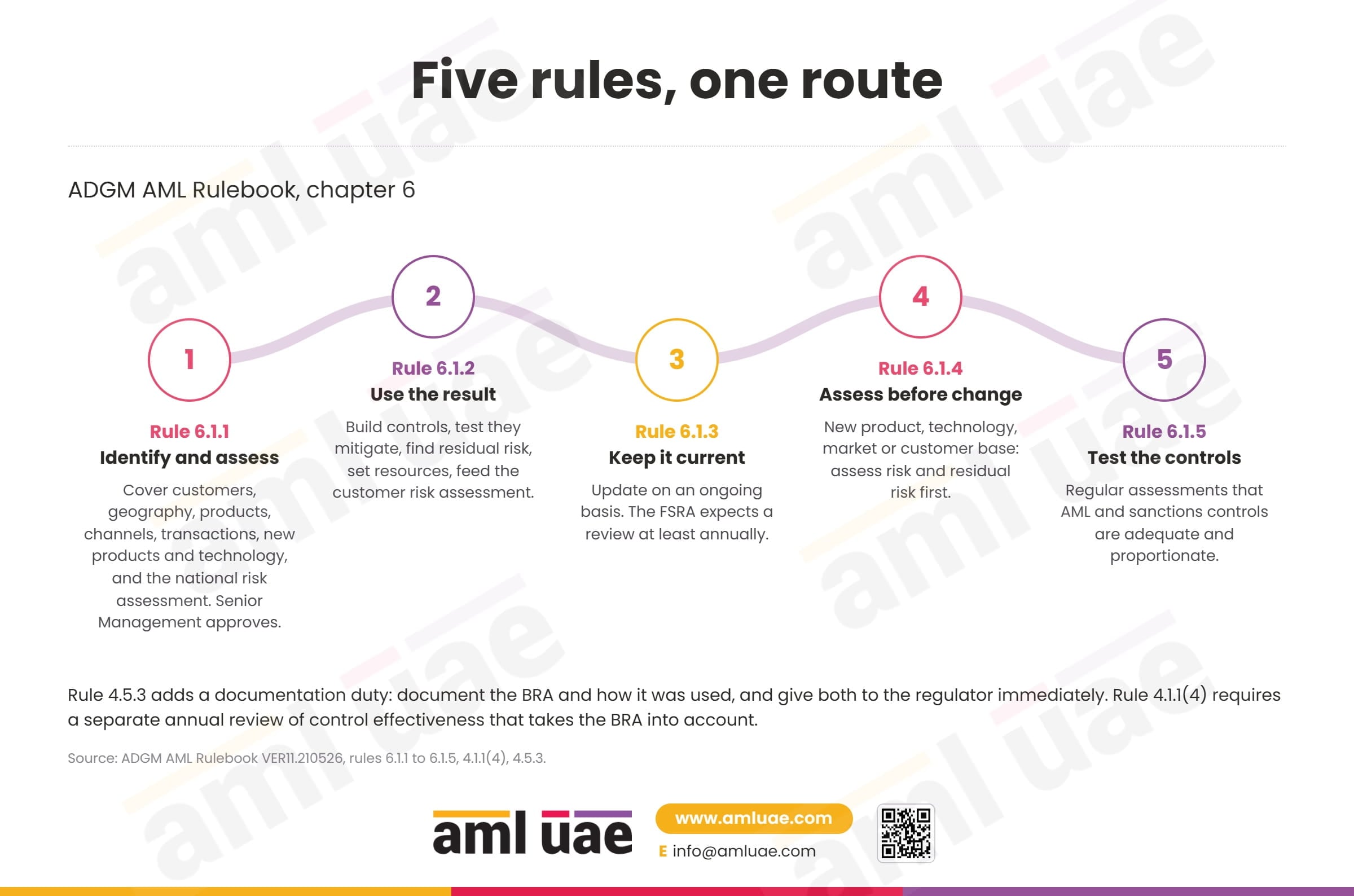
The ADGM AML Rulebook, chapter 6, requires each firm it covers to identify and assess the money laundering risks of its own business, have senior management approve the assessment, keep it up to date and use it to set controls. Money laundering risk here includes terrorist financing, proliferation financing and sanctions breaches, including targeted financial sanctions.
Status : binding requirement.
What must the ADGM AML rules make you consider?
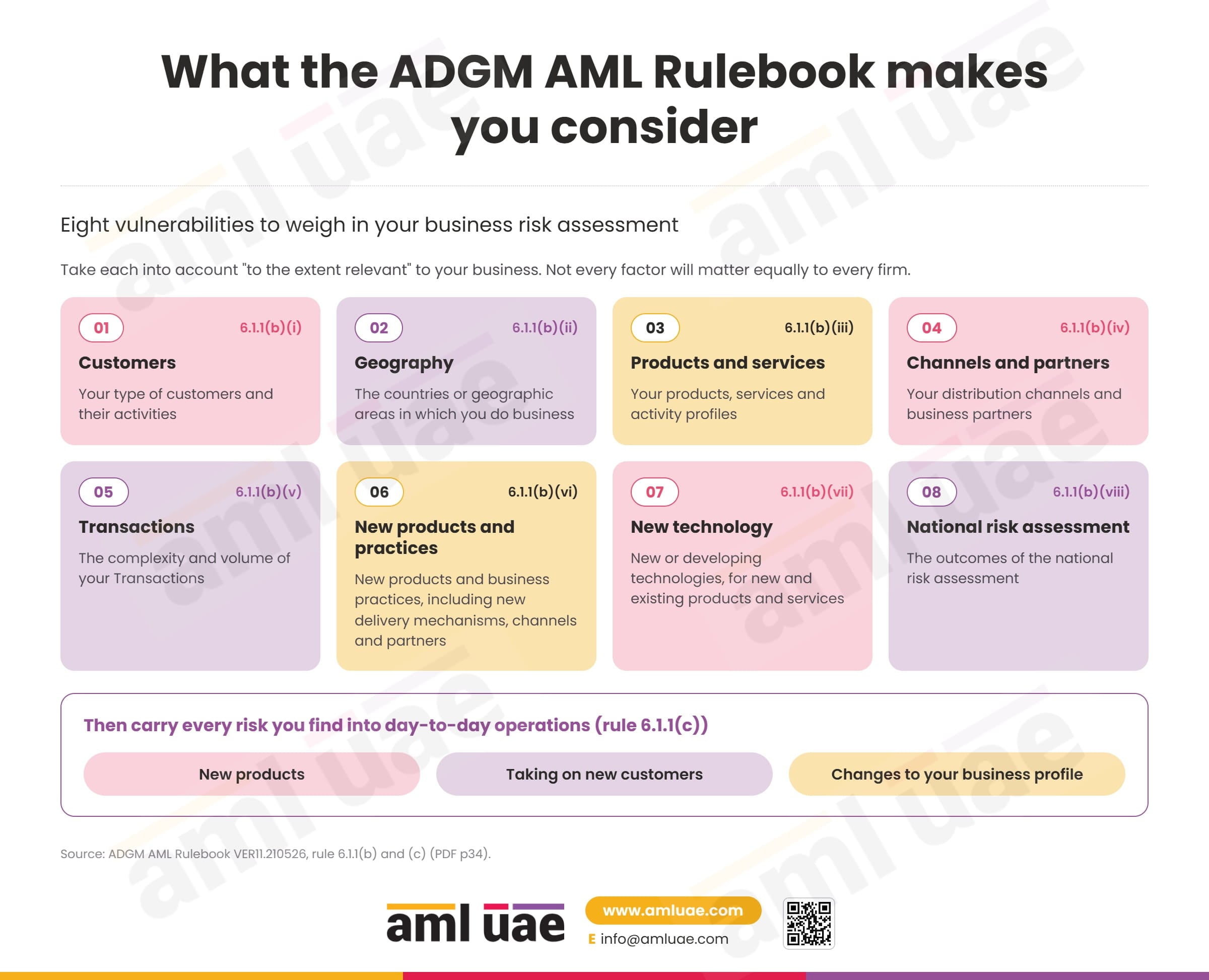
As far as they are relevant to your business, you must take into account:
- the types of customers you have and what they do
- the countries where you do business
- your products, services and activity profiles
- your delivery channels and business partners
- the complexity and volume of your transactions
- new products, practices and technology
- the outcomes of the national risk assessment
What does "proportionate" mean for a small firm?
Rule 6.1.1 ties the assessment to the nature, size and complexity of your activities. A small firm can have a shorter assessment than a bank, but it cannot skip the factors, the sanctions component, the approval or the evidence. Length is not the test. The test is whether a reviewer can follow your reasoning.
Does the ADGM business risk assessment have to cover fraud, cyber security and other financial crime?
Yes. The guidance under rule 6.1.5 of the ADGM AML Rulebook says the business risk assessment should also assess your exposure to other financial crime, such as fraud and the theft of personal data, and to cyber security risk, because a cyber weakness can affect your ability to prevent financial crime. Rule 6.1.5 itself requires regular risk assessments of whether your AML and sanctions systems and controls are adequate, comprehensive and proportionate.
Status: binding requirement (rule 6.1.5) and supervisory expectation (its guidance).
The guidance to rule 6.1.5 expects six things on top of the core factors:
- Method: identify the risks, assess the relevant controls and quantify the residual risk (guidance paragraph 3).
- Other financial crime: assess your exposure to fraud and the theft of personal data, not only money laundering (paragraph 4).
- Cyber security: assess cyber security risk, because it can weaken your ability to prevent financial crime (paragraph 4).
- Sanctions: carry out a targeted financial sanctions risk assessment, including proliferation financing and terrorist financing, as a clearly identifiable part of the assessment (paragraph 5).
- New products, technology and non-face-to-face business: before launching anything new or using new technology, look at every form of financial crime it could open up. eKYC may cut impersonation fraud at onboarding, but non-face-to-face relationships can raise the risk of transaction fraud, money laundering and theft of digitally stored CDD documents later (paragraphs 6 to 8).
- External events: update the assessment for new typologies, regulatory change, audit and supervisory findings including thematic reviews, and updates to the national risk assessment (paragraph 9).
In our practice, the simplest way to do this is to add fraud, data theft and cyber rows to the risk register, take the latest information security or IT risk review as evidence, and rate them like any other factor. A small firm can do this in a few lines, but it should not leave them out.
What must you do with the business risk assessment result?
Use it to build and test your controls, understand the residual risk, set priorities and carry out each customer risk assessment. Keep it up to date, assess the risk before you launch anything new, and regularly test that your systems and controls are adequate.
What must you be able to produce?
You must document the business risk assessment and how you used it, and give both to the regulator immediately if asked. A review of how well your controls work must also happen at least once a year, and it must take the assessment into account.
What does the FSRA's April 2026 guidance add to the ADGM business risk assessment?
FSRA Notice 62/2026 of 10 April 2026 sets out how the FSRA expects a business risk assessment to be built and documented. It is guidance, not a new rule, but it shows what a supervisor will look for: a clear method, justified ratings, tested controls, and records of approval and review. Its text reminds all Relevant Persons, including DNFBPs.
Status : supervisory expectation.
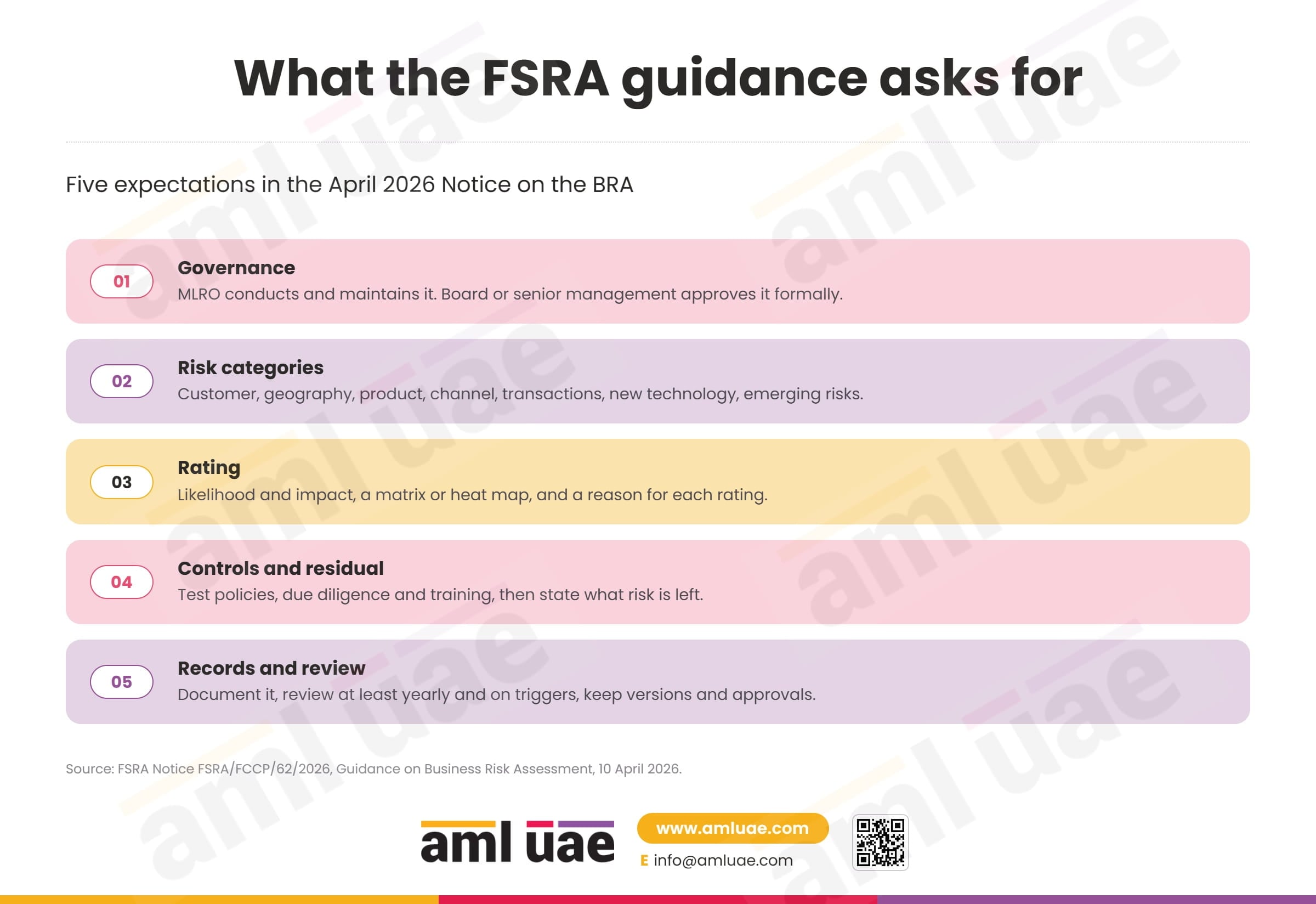
Governance
The MLRO conducts and maintains the assessment. The board or senior management oversees it and approves it formally.
Risk categories and rating
The notice lists customer, geography, product or service, delivery channel, transactions, new developments and technology, emerging risks and anything specific to your business. Rate likelihood and impact, use a matrix or heat map and justify each rating.
Controls, residual risk and records
Evaluate your policies, due diligence and training, then work out the risk that is left. Record the assessment, review it at least annually and on triggers, and keep version control and a record of approvals.
What have the regulators found in ADGM business risk assessments?
Regulators have found the same weaknesses at virtual asset firms and DNFBPs: assessments that are generic, miss risk factors, leave sanctions risk out, are not approved or versioned, or go out of date. The fix is a documented method, firm-specific ratings and a record that the assessment shaped your controls.
Status : supervisory expectation (findings).
What has the FSRA found at virtual asset firms?
The FSRA’s October 2025 review of licensed virtual asset firms found a small number of assessments that were generic, left out important risk factors, lacked a clear method or did not connect to the controls. The FSRA expects a well-documented assessment that covers all the financial crime risks, reviewed regularly and whenever something material changes. It reads as a quality test for any firm.
What has the Registration Authority found at DNFBPs?
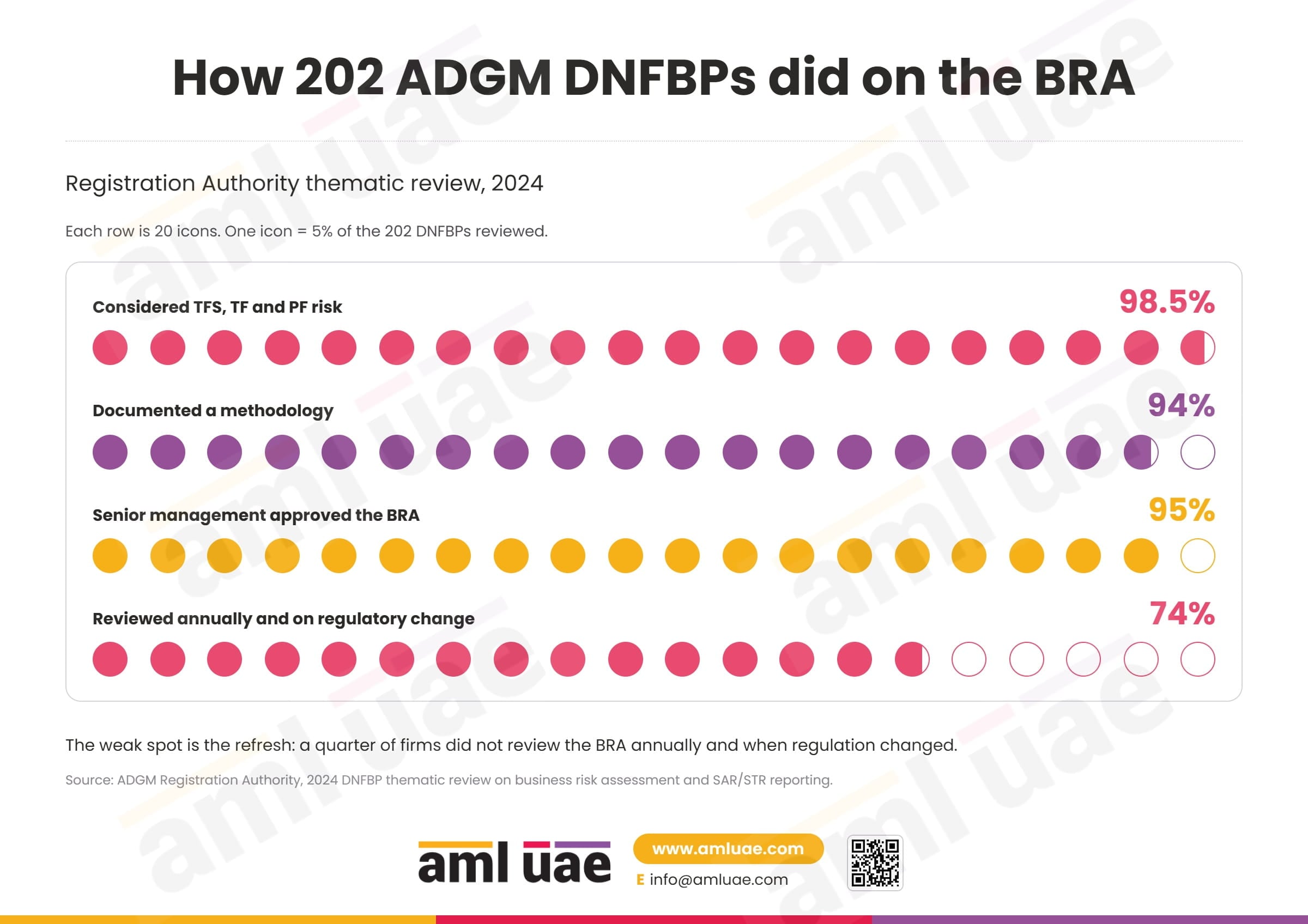
Most DNFBPs have the basics, but fewer keep the assessment current. The RA’s 2024 review of 202 DNFBPs found 98.5% considered sanctions, terrorist financing and proliferation financing, 94% had documented a method and 95% had senior management approval. Only 74% reviewed the assessment annually and when things changed.
The RA’s 2025 findings report (June 2026) covers 35 onsite assessments and almost 400 supervised DNFBPs. It found sanctions risk not shown as its own component, weak version control and approval records, assessments not kept current, key factors missing, and annual reviews treated as a procedure and not a real test.
Which national and ADGM risk assessments should you use?
Use the national risk assessments, the UAE proliferation financing assessment and the RA’s ADGM legal persons report as inputs, then justify your own ratings. The UAE national ML/TF assessment rates overall risk Medium-High and rates sectors, so find the rating for your own type of firm. The UAE proliferation financing assessment also rates overall risk Medium-High.
In May 2026 the RA published an update of its risk assessment of ADGM legal persons and arrangements. It rates private companies limited by shares and general foundations Medium-High and public companies Low. Its ratings are indicative sector guidance, not a judgement on any one business, and the FSRA’s Notice 91/2026 of 1 June 2026 encourages firms to consider the report but requires no action.


“A sector rating tells you where the average firm sits. It does not tell a reviewer why your firm is rated the way it is. Each firm has to justify its own risk ratings. “

How do you build an ADGM business risk assessment?
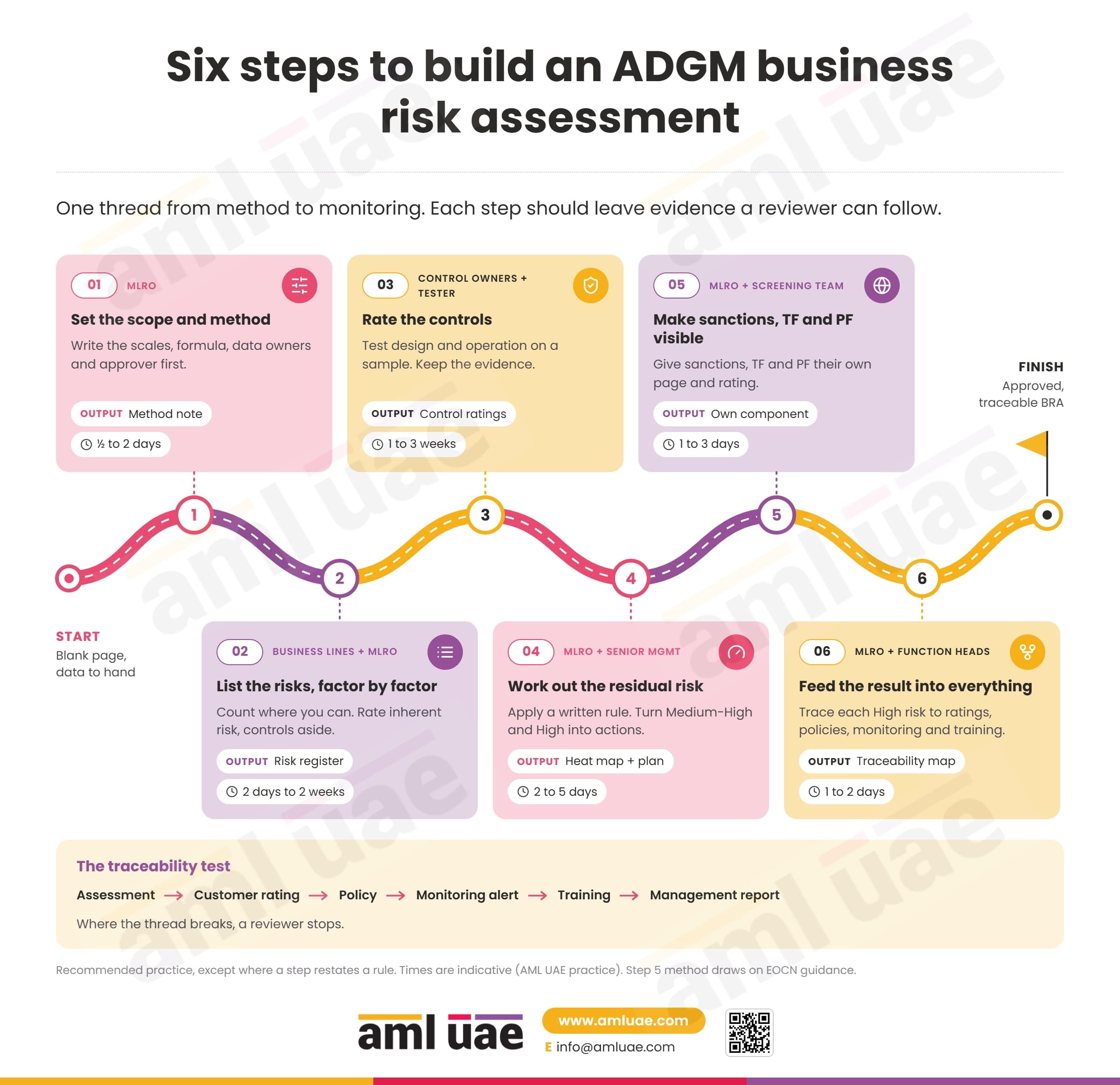
Build the assessment in six steps: set the method, list the risks by factor, rate the controls, work out the residual risk, give sanctions, terrorist financing and proliferation financing their own component, then feed the result into your customer risk ratings, policies and monitoring. Each step should leave evidence a reviewer can follow.
The AML business risk assessment template for DNFBPs and our guide on how to conduct a business risk assessment are good places to start. Prefer to watch first? Our video on the business risk assessment covers risk factors, risk appetite, residual risk and control effectiveness.
Status : recommended practice, except where a step restates a rule.
Step 1. Set the scope and method
Write down how you will rate risk before you rate anything: the scales for likelihood and impact, who does the work, who approves and where the data comes from. Without a written method, two people rating the same risk will give different answers and a reviewer cannot tell which to trust.
Who: the MLRO or compliance lead owns it, with a named approver in senior management. Output: a one to two page method note. Indicative time (our practice): half a day to two days, depending on firm size.
How to do it:
- Choose a scale. Four levels (Low, Medium, Medium-High, High) is common and matches the ADGM sector ratings.
- Define likelihood and impact in your own words, with one example for each level.
- State the formula that joins them: the likelihood and impact matrix in Table 7 and the control rule in Table 8.
- Name the data owner for each factor, for example onboarding for customer data and operations for transaction data.
- Record the approver and the review date.
TIP
Define each rating level with an example from your own business. “High impact: a layered structure hides who owns the client” is far easier to apply than “High: severe”.
Step 2. List the risks, factor by factor
Count things where you can, such as how many customers come from high-risk countries. A rating built on counts can be defended. A rating built on a feeling cannot. Our list of factors for a business risk assessment is a useful checklist.
Who: each business line supplies the data and the MLRO consolidates it. Output: a risk register with one row per risk and the evidence behind it. Indicative time (our practice): two days to two weeks, mostly spent collecting data.
How to do it:
- For each factor in the table below, pull the numbers from your onboarding, transaction and complaints data.
- Write each risk as a sentence, for example “Non-resident clients with layered ownership could hide the beneficial owner.”
- Rate likelihood and impact using your scales, with no controls in mind yet. This is inherent risk.
- Write the reason for each rating in one sentence. If you cannot, you do not yet have the evidence.
- Note the data gaps. A gap you admit is better than a number you invented.
INSIGHT
Rate inherent risk before you think about controls. Firms that rate with their controls in mind drift towards Low, and the controls then look unnecessary on paper.
| Factor | What to look at | What to record |
|---|---|---|
| Customers | Types, residency, complex ownership, high-risk industries, PEPs | Counts by type and risk, with the source |
| Geography | Where you operate and where customers and counterparties are | Exposure to high-risk countries |
| Products and services | What you offer and what is new | Which are exposed to which risks |
| Channels and partners | Face to face, online, agents, intermediaries | Where identity is not seen in person |
| Transactions | Cash, cross-border, third-party payments, volume | Patterns unusual for the profile |
| Technology | New or changing systems, non-face-to-face onboarding and eKYC, cyber security | Risks the technology adds or removes, including fraud, theft of personal data and cyber attack |
| Sanctions, terrorist financing and proliferation financing | Exposure to listed parties and proliferation risk | A separate, visible component |
What do the risk factors look like for your type of firm?
The factors are the same for everyone. What drives them differs. These are typical drivers to test against your own data. They are not a regulator list. Where the RA quick guide gives its own example, it is noted.
| Firm type | Typical drivers to test | Evidence to record |
|---|---|---|
| Banks and other Authorised Persons | Cross-border payments, correspondent or intermediary relationships, PEP and high-risk customers, complex ownership, cash | Customer counts and volumes by risk band, product-level risk notes, control test results |
| Payment, virtual asset and fintech firms | Non-face-to-face onboarding, fast-moving products, virtual asset transfers, new technology, partners and agents | Onboarding channel mix, transfer volumes by corridor, partner and vendor list, technology change log |
| Company service providers | Non-resident clients, layered or nominee structures, introducers. The RA guide's example rates non-resident clients likely and high impact, managed with enhanced due diligence | Client counts by residency and structure, introducer register, how ownership is verified |
| Law firms | Holding client money, non-resident or high-risk clients, complex structures. The RA guide's example treats client bank accounts as high risk | Client account activity, matter types, beneficial owner checks |
| Accountants and auditors | Client types, advice on structures, third-party payments | Client mix, engagement types, source-of-funds checks |
| Dealers in precious metals and stones | Cash, high-value items, cross-border trade. The RA guide's example rates cash above AED 55,000 as almost certain and high impact | Cash counts and thresholds, supplier and buyer checks |
| Real estate agencies | Cash or third-party payments, non-resident buyers, speed of transactions | Payment methods, buyer residency mix, source-of-funds checks |
Step 3. Rate the controls
For each risk, say what control reduces it and how well it works. Test design and operation and keep the evidence. A control that exists but is not tested has not been shown to work.
Who: control owners describe the control, and compliance or an independent tester checks it. Output: a control rating for each risk, with test notes. Indicative time (our practice): one to three weeks.
How to do it:
- Map each risk to the controls that address it, such as enhanced due diligence, screening, monitoring or approval limits.
- Test design: would this control stop the risk if it worked as written?
- Test operation: take a sample and check it worked in practice. Record the sample size, the date and the result.
- Rate effectiveness on a simple scale: Effective, Partly effective, Not effective.
- Log every weakness with an owner and a date to fix it.
| Control rating | What it means | Evidence a reviewer will expect |
|---|---|---|
| Effective | Designed to cover the risk and worked in the sample | Test sheet and sample results |
| Partly effective | Designed well but with gaps in operation | Test sheet and a dated fix plan |
| Not effective | Missing or failing | The weakness log and escalation to senior management |
WATCH OUT
Do not rate a control as effective because a policy says it exists. Reviewers ask for the test, not the policy.
Step 4. Work out the residual risk
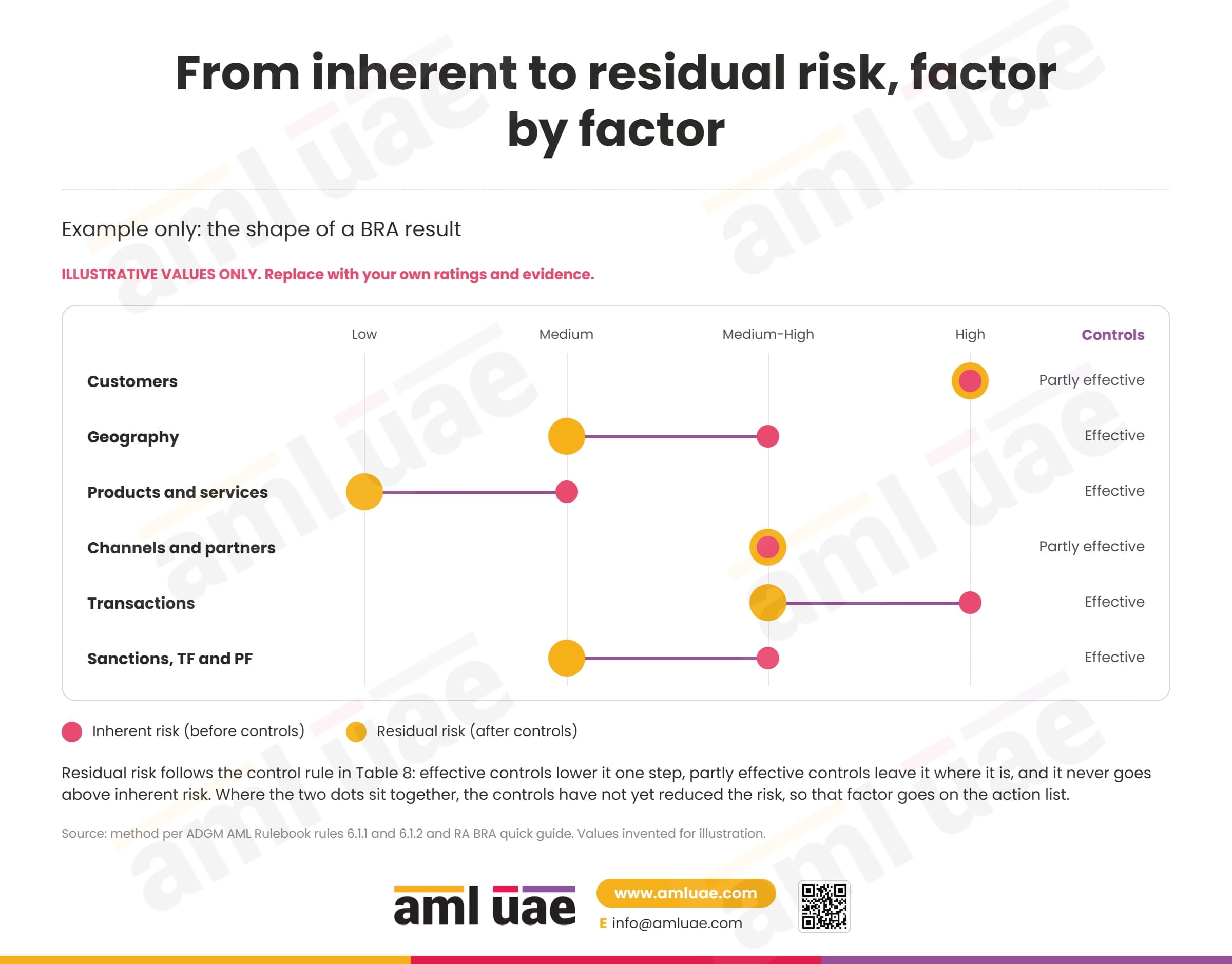
What is left after controls is the residual risk. The law does not require a particular score. It requires that your ratings are justified and that management can see where the exposure is.
Who: the MLRO proposes, and senior management challenges and approves. Output: residual ratings, a heat map and a short list of priority actions. Indicative time (our practice): two to five days.
How to do it:
- Rate inherent likelihood and impact on your scales, then read the inherent rating from the matrix (Table 7).
- Apply the control rule (Table 8) to set the residual rating. Controls can lower the rating by one level at most, and residual risk never goes above inherent risk. Both tables are our practice, not a regulatory scale.
- If a weak control creates a new exposure, record that as its own risk with its own rating. Do not raise a residual rating above inherent risk to show it.
- Write the reason for the residual rating in the firm’s own words.
- Show the result on a heat map of inherent and residual risk.
- Turn every residual rating that is Medium-High or High into an action with an owner and a date.
| Likelihood | Impact: Low | Impact: Medium | Impact: High | Impact: Very high |
|---|---|---|---|---|
| Almost certain | Medium-High | High | High | High |
| Likely | Medium | Medium-High | High | High |
| Possible | Low | Medium | Medium-High | High |
| Unlikely | Low | Low | Medium | Medium-High |
| Inherent rating | Controls Effective | Controls Partly effective | Controls Not effective |
|---|---|---|---|
| High | Medium-High | High | High |
| Medium-High | Medium | Medium-High | Medium-High |
| Medium | Low | Medium | Medium |
| Low | Low | Low | Low |
TIP
Keep one page for senior management: the heat map, the top five residual risks, what you will do about each and by when. That is the page they actually read.
Illustrative example: rating one factor in a business risk assessment
This is an illustration with invented figures, not a client case. It shows the part reviewers look for most: the written reason for each rating.
| Item | Illustrative entry for the customer factor at a company service provider |
|---|---|
| Inherent likelihood | Likely: a large share of this firm's clients are non-resident |
| Inherent impact | High: layered structures can hide who owns the client |
| Inherent rating | High (Likely and High, read from Table 7) |
| Controls | Enhanced due diligence for non-resident clients, beneficial owner verification, senior approval for complex structures |
| Control effectiveness | Partly effective: file testing found some late ownership checks |
| Residual rating | High (partly effective controls leave the rating where it is, under Table 8) |
| The reason, in the firm's words | "Most of our clients are non-resident and use layered structures, so inherent risk is High. Enhanced due diligence works on file testing, but ownership checks on some nominee structures were late, so the controls are only partly effective and residual risk stays High until that is fixed. The fix is on the action list with an owner and a date." |
Step 5. Carry out a proliferation financing (PF) risk assessment and make sanctions visible
Give sanctions, terrorist financing and proliferation financing their own component and rating. The guidance under rule 6.1.5 expects this as a clearly identifiable element of the assessment.
The UAE Executive Office for Control and Non-Proliferation (EOCN) gives a useful method: assess inherent risk, test the controls, then set residual risk, using customers, business activity, geography, products and transactions, delivery channels and cyber threats. Its guidance dates from before the 2025 law, so use it for method and cite current law for the obligation. Our guide to the proliferation financing institutional risk assessment and to targeted financial sanctions covers it in more detail.
Who: the MLRO, with whoever runs sanctions screening. Output: a separate sanctions, terrorist financing and proliferation financing section with its own rating. Indicative time (our practice): one to three days.
How to do it:
- Give the component its own page and rating, not a paragraph inside the general assessment.
- For each factor (customers, activity, geography, products, channels, cyber), ask how a listed person or a proliferation network could reach you.
- Test the controls: screening coverage, list update timing, freeze and reporting steps, and staff knowledge.
- Set the residual rating and write the reason.
- Say what changed since last time.
WATCH OUT
A recurring finding is a sanctions component that is not clearly identifiable. If a reviewer cannot find yours in under a minute, treat it as missing.
Step 6. Feed the result into everything else
The assessment should shape your customer risk ratings, policies, monitoring, training and resourcing. The RA also publishes a non-binding quick guide with illustrative examples. Use it for ideas, not as a template, and cite the rulebook, not the guide, for rule numbers.
Who: the MLRO with the heads of onboarding, monitoring and training. Output: a traceability map. Indicative time (our practice): one to two days, then reviewed each cycle.
How to do it:
- For each High or Medium-High residual risk, name the customer rating factor it changes.
- Name the policy section, monitoring scenario or training module that responds to it.
- Record any resource change, such as an extra analyst or a system change.
- Keep the map with the assessment so a reviewer can follow one thread from risk to action.
| Residual risk | Customer rating effect | Policy or procedure | Monitoring | Training |
|---|---|---|---|---|
| Non-resident clients with layered ownership | Higher base score for non-resident, layered structures | Beneficial owner verification section | Alert on late ownership checks | Module for onboarding staff |
INSIGHT
The traceability test. Pick one High risk and follow it: assessment, customer rating, policy, monitoring alert, training, management report. Wherever the thread breaks, that is where a reviewer will stop.
CHECKLIST
- Method note is signed and dated
- Every rating has a written reason
- Sanctions, terrorist financing and proliferation financing are a separate component
- Heat map and top five actions are on one page
- Approver, date and version are on the cover
- Trigger register is attached
- Customer ratings and controls trace back to it
How do you take the business risk assessment to senior management?
Present a short pack and ask for a decision, not just a signature. The pack has the method, the heat map, the top residual risks with actions, what changed since the last version and the sanctions component. Minute the discussion, any challenge and the approval, and record the version.
What does a 30-day plan look like for a firm starting from scratch?
This plan is our practice, for a small or medium firm with data available. Large firms need longer.
| Week | Task | Owner | Output |
|---|---|---|---|
| 1 | Agree method and scales, name data owners | MLRO and senior management | Signed method note |
| 2 | Collect data and list risks by factor | Business lines and MLRO | Draft risk register with reasons |
| 3 | Test controls, rate residual risk, build the sanctions component | MLRO and testers | Control ratings and heat map |
| 4 | Draft the pack, challenge, approve and minute | Senior management | Approved version 1.0 and a started trigger register |
Common mistakes to avoid
These are the weaknesses the regulators’ findings point to, and the ones we flag in our own review work.
- copying a template without putting your own data in it
- giving ratings with no written reason
- folding sanctions, terrorist financing and proliferation financing into a general paragraph
- leaving out the approval date, the approver or the version history
- assessing once and never refreshing, even after launching something new
- treating a score as the rule instead of the reasoning behind it
- keeping the assessment apart from the customer risk ratings and controls
- treating the annual controls review as a form to sign
- assessing money laundering only and leaving out fraud, theft of personal data and cyber security risk
“The template is the easy bit. The hard part is the rating column. When I review an assessment, I look for the sentence that says why a factor is rated High or Low for that firm. If that sentence could sit in anyone’s assessment, it is not yet yours.”

Need the method built and approved?
AML UAE's business risk assessment service builds a documented method, ratings and an approval pack for ADGM firms.
How do you set a risk appetite for your ADGM business risk assessment?
A risk appetite statement says how much money laundering, terrorist financing and proliferation financing risk your firm will accept. Your ADGM business risk assessment shows what the risk is. Your appetite decides what you do about it: accept it, add controls, limit the activity or stop it.
Status : supervisory expectation (good practice in the Registration Authority’s 2024 thematic review). The ADGM AML Rulebook does not use the term, so this is not a stand-alone rule.
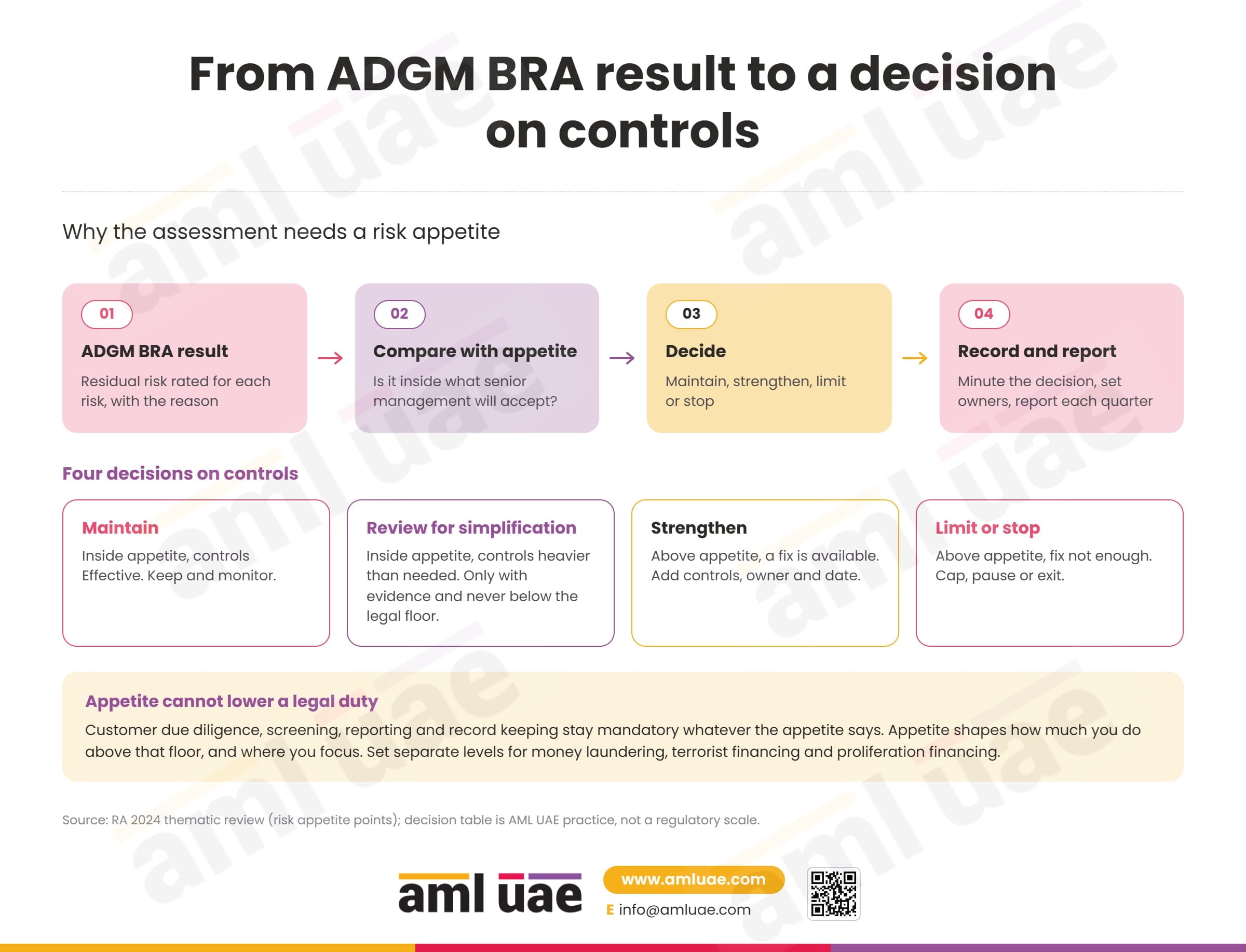
Why does the ADGM business risk assessment need a risk appetite?
Without an appetite, a rating has nowhere to go. A residual rating of Medium-High is only information until someone decides whether the firm accepts it. Appetite is the yardstick that tells you when to add controls, when existing controls are enough and when an activity falls outside what the firm will do.
INSIGHT
Appetite is the missing step between a rating and an action. The assessment says where you are. The appetite says where you are willing to be. The gap between the two is your control plan.
“Ratings do not decide anything. Appetite does. Until senior management has said which residual risks it will accept, the assessment is a description and not a control plan.”
What does the Registration Authority say about risk appetite?
The RA’s 2024 review of DNFBPs links the business risk assessment to risk appetite in four ways, summarised below. These are observations and good practice, not rules, and they are written for DNFBPs. Banks and other FSRA-supervised firms should read them as a useful benchmark.
| Point from the RA review | What it means in practice |
|---|---|
| Good practice: the appetite is approved by senior management and referred to in the policies and the BRA, for money laundering, terrorist financing and proliferation financing | Put the appetite in front of the board or senior management, minute the approval and cross-refer it |
| Improvement area: firms with large-scale operations should consider a risk appetite statement scaled to their business | Larger and more complex firms are expected to have a written statement |
| Improvement area: set separate levels for money laundering, terrorist financing and proliferation financing, not one level for all | A single level suggests you see all three risks as equal. State each one |
| Good practice: residual risk is matched to the appetite, and a gap triggers an action plan and a report to senior management | Compare every residual rating with the appetite and escalate any breach |
What goes into a risk appetite statement?
A good statement is short, specific to your firm and testable. It has a scope, plain statements of what you will and will not accept, a few measurable limits, an owner and a review date. This layout is our practice, not a regulatory format.
| Part | What to write | Illustrative wording (invented, replace with your own) |
|---|---|---|
| Scope | Which risks it covers, stated separately | Money laundering, terrorist financing, proliferation financing and sanctions each have their own statement |
| Will not accept | Activities or clients outside appetite | We will not onboard a client whose beneficial owner we cannot verify |
| Will accept with conditions | Risk you accept only with specific controls | We accept Medium-High residual risk for non-resident clients only while enhanced due diligence is rated Effective |
| Measures | Two to five indicators with a limit | Share of high-risk clients, overdue ownership checks and screening alert ageing, each with a limit set by the firm |
| Ownership | Who approves, who monitors | Senior management approves. The MLRO reports against it each quarter |
| Review | When it is revisited | Each year, and after any change to the business or the assessment |
TIP
Write each statement so a junior analyst could apply it without asking you. “Low appetite for risk” is a slogan. “We do not accept clients whose ownership we cannot verify” is a rule they can follow.
How do you set the risk appetite, step by step?
Start from your BRA results, draft the statements, agree measures, take it to senior management for a real decision and then link it to your policies and monitoring. Set it after the first assessment and then revisit it each cycle.
Who: the MLRO drafts, senior management decides. Output: an approved statement of one to two pages. Indicative time (our practice): one to three weeks, including the senior management discussion.
- List your High and Medium-High residual risks from the assessment.
- For each, ask senior management: will we accept this, reduce it or exit it?
- Write the answer as a statement for money laundering, terrorist financing, proliferation financing and sanctions separately.
- Choose two to five measures and set a limit for each.
- Take the draft to senior management, allow challenge and minute the approval.
- Link the statement to your policies, customer acceptance rules and customer risk ratings.
- Report against it each quarter and revisit it at each annual refresh.
How do you turn the risk appetite into decisions on controls?
Compare each residual rating with the appetite and take one of four decisions: maintain, simplify, strengthen, or limit or stop. The decision, who made it and why must be recorded. This is how the BRA decides where controls are added and where effort is better spent.
| Residual risk against appetite | Decision | What it looks like | Evidence |
|---|---|---|---|
| Within appetite, controls Effective | Maintain | Keep controls, monitor the measures | Quarterly report |
| Within appetite, controls heavier than the risk needs | Review for simplification | Propose a lighter control on the evidence, with senior approval. Never go below what the law requires | Test results, senior management minute |
| Above appetite, a fix is available | Strengthen | Add or improve controls, set an owner and date | Action plan, re-test |
| Above appetite, fix not enough | Limit or stop | Cap exposure, pause the product or segment, or exit | Senior management decision on record |
WATCH OUT
Risk appetite cannot lower a legal duty. Customer due diligence, screening, reporting and record keeping stay mandatory whatever the appetite says. Risk appetite shapes how much you do above that floor and where you focus.
CHECKLIST
- Appetite statement is approved by senior management and minuted
- Money laundering, terrorist financing, proliferation financing and sanctions each have a statement
- Statements say what you will not accept
- Two to five measures have limits
- Every residual rating is compared with the appetite
- Breaches have an action plan and are reported
- The statement is cross-referred in the policies and the BRA
For more on the concept, see our guides on risk appetite in a risk-based approach and on risk universe, risk tolerance and risk appetite.
How do you operationalise and embed the ADGM business risk assessment?
To operationalise the ADGM BRA, give it owners, a reporting rhythm, links to controls, staff awareness and a review calendar, so it drives decisions every month and not only once a year. The RA expects BRA results in management reporting and staff to know the key risks.
Status : supervisory expectation (RA 2024 thematic review and FSRA Notice 62/2026), with the detail below our practice.
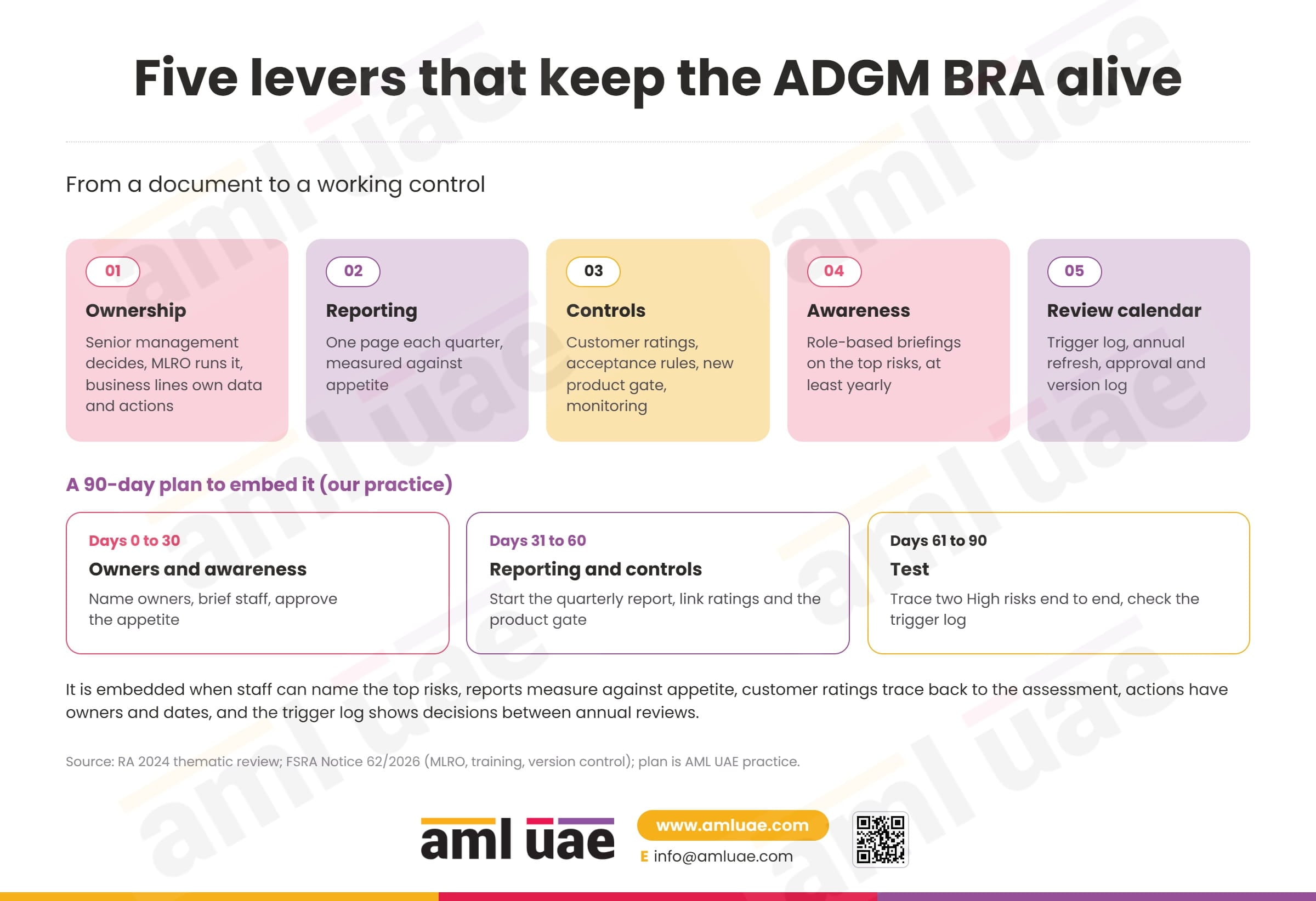
What does it mean to operationalise the ADGM business risk assessment?
It means the assessment changes what people do. The ratings feed customer onboarding and monitoring. The results appear in reports management actually reads. Staff know the top risks. Someone owns each action. The assessment is refreshed on a calendar. If none of that happens, the assessment is a document and not a control.
WATCH OUT
Shelfware. An assessment that is approved, filed and never opened again does not work as a control. If a new joiner cannot say what your top three risks are, it is not embedded.
Who owns what?
Senior management owns the decision, the MLRO owns the process and each business line owns its data and actions. The FSRA’s April 2026 guidance says the MLRO should be assigned to conduct and maintain the assessment, with the board or senior management overseeing and approving it. The split below is our practice.
| Role | Owns | Does each cycle |
|---|---|---|
| Senior management or board | Appetite and approval | Challenges the pack, approves the version and the appetite, decides on limits and exits |
| MLRO or compliance lead | The process and the document | Runs the assessment, keeps the register and triggers, reports against appetite |
| Business line heads | Data and actions | Supply data, own mitigation actions, flag changes early |
| Compliance testers or internal audit | Control testing | Test controls and report results to the MLRO and senior management |
| Training lead | Awareness | Turns the top risks into role-based briefings |
How do you build management information from the ADGM business risk assessment?
Pick a handful of indicators that track your top residual risks, give each an owner and a limit from your risk appetite, and report them on one page each quarter. The RA says BRA outcomes should feed regular reporting so management can decide on appetite and resources.
| Indicator (illustrative) | Risk it tracks | Owner | Limit |
|---|---|---|---|
| Share of clients rated high risk | Customer risk | MLRO | Set by the firm in the appetite statement |
| Overdue beneficial owner checks | Layered structures | Onboarding lead | Set by the firm |
| Screening alert ageing | Sanctions risk | Screening lead | Set by the firm |
| Controls rated Partly or Not effective | Control gaps | Compliance testers | Set by the firm |
| Open mitigation actions past their date | Follow-through | MLRO | Set by the firm |
| Trigger events logged and decided | Currency of the BRA | MLRO | Set by the firm |
| Staff trained on the latest BRA | Awareness | Training lead | Set by the firm |
TIP
Put the appetite measures at the top of the quarterly MLRO report, with a red, amber or green flag against each limit. One page, seven indicators at most.
How do you make staff aware of the ADGM business risk assessment?
Give each role a short briefing on the risks that matter to it, and refresh it at least once a year. The RA says staff should know the outcomes of the assessment, and the FSRA’s April 2026 guidance expects role-specific training at least annually. In our practice, a one-page summary and a short session are enough to start.
- Write a one-page summary of the top five risks and what each role must do differently.
- Add it to new-joiner induction.
- Brief onboarding, monitoring and relationship teams in their own terms, with real examples from your business.
- Re-brief after each approved version or major trigger.
- Keep a training record for each session: date, attendee, role, the version of the assessment covered and the result of any short test.
- As recommended evidence practice, keep the exact slides, videos, handouts or briefing materials used, identified by version and date and linked to that session’s training record. This is our practice, not a stated rule.
- Chase anyone who missed it and record the date they finished.
- Review attendance and results once a year with the refresh, and add a module when a trigger changes a High or Medium-High rating.
How do you link the ADGM business risk assessment to onboarding and change?
Make the assessment a gate. Customer risk factors should come from it, customer acceptance rules should follow your appetite, and every new product or market should pass a short risk check before launch. The rulebook already requires you to assess risk before introducing something new, so use the same gate for this.
| Link | How it works |
|---|---|
| Customer risk assessment | Factors and weights come from the BRA and are updated when it changes |
| Customer acceptance | Accept, escalate or decline rules reflect the appetite |
| New product gate | A short assessment is signed off by the MLRO before launch |
| Monitoring | Scenarios and thresholds respond to the High and Medium-High risks |
| Resourcing | Staffing and systems requests cite the residual risk |
What does a 90-day embedding plan look like?
Spend the first 30 days on ownership and awareness, the next 30 on reporting and controls, and the last 30 on a test. This plan is our practice and assumes your assessment is approved.
| Days | Focus | What happens | Output |
|---|---|---|---|
| 0 to 30 | Owners and awareness | Name owners for each action. Brief all staff on the top risks. Approve the appetite | Action owners, briefing record, appetite statement |
| 31 to 60 | Reporting and controls | Start the quarterly one-page report. Link customer ratings and the new product gate. Rework weak controls | First report, updated procedures |
| 61 to 90 | Test | Run the traceability test on two High risks. Check the trigger log. Report to senior management | Test notes and an updated action plan |
How do you know the ADGM business risk assessment is embedded?
Five signs show it: your staff can name the top risks, your reports measure against the appetite, your customer ratings trace back to the assessment, your actions have owners and dates, and your trigger log shows decisions between annual reviews. If one is missing, that is the next thing to fix.
INSIGHT
Ask one question every quarter: are we still within our risk appetite, and how do we know? A firm that can answer it from a one-page report has embedded its BRA.
CHECKLIST
- Every action has an owner and a date
- Top five risks are in new-joiner induction
- Quarterly report measures against the appetite
- Customer ratings and acceptance rules trace to the BRA
- New products pass a risk check before launch
- Trigger log shows decisions including no change
- Training record shows who attended, which version they covered and the materials used
When must you update the ADGM business risk assessment?
Review the assessment at least once a year and whenever something material changes. Triggers include a new product, technology, market or customer base, a new business model, a national risk assessment update, new regulation, FATF or sanctions list changes that affect your exposure, audit or supervisory findings and new typologies. Record each trigger and decision.
Status : binding requirement to keep it current and to assess before new products, technology, markets or customer changes (rules 6.1.3 and 6.1.4); supervisory expectation for the yearly review and external events (guidance to rule 6.1.5); our practice for the FATF and sanctions list prompts.
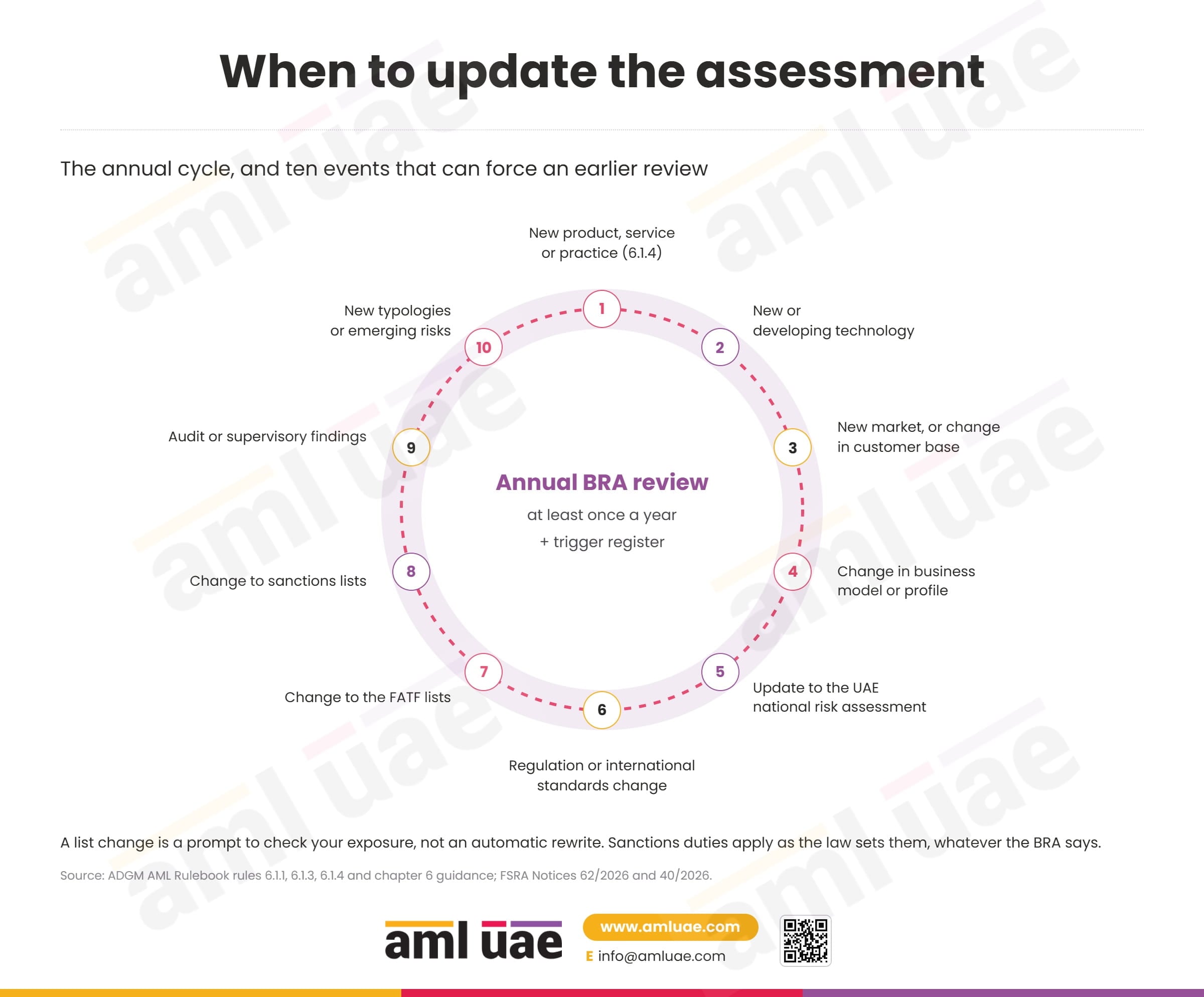
What triggers an update to the business risk assessment?
A new product, market, technology or customer base, a change in your business model, or a change in regulation, findings or typologies should each prompt a review. A change to the FATF or sanctions lists prompts a check of your exposure. The table lists the ten triggers and why they matter.
| Trigger | Why |
|---|---|
| New product, service or business practice | Assess before launch (rule 6.1.4) |
| New or developing technology | Assess before use (rule 6.1.4) |
| Entering a new market, or a change in your customer base | Assess before the change (rule 6.1.4) |
| Change in your business model or profile | The assessment must reflect the business (rule 6.1.3 and guidance 2) |
| Update to the national risk assessment, including the proliferation financing assessment | Must be taken into account (rule 6.1.1(b)(viii)) |
| Change in regulation or in guidance from international standard-setters | FSRA guidance expects a review (guidance 9 to rule 6.1.5) |
| Change to the FATF lists of high-risk jurisdictions and jurisdictions under increased monitoring | Rule 11.2.1 and Notice 40/2026 expect you to stay informed and act. Check your customer, partner and transaction exposure to countries added or removed (our practice for the assessment) |
| Change to a sanctions list, or a new sanctions regime that reaches your customers, countries or products | Screening, freezing and reporting duties apply as the law sets them (rule 11.2.1). Revisit the assessment only if your exposure changes (our practice) |
| Audit or supervisory findings, including thematic reviews | FSRA guidance expects a review (guidance 9 to rule 6.1.5) |
| New money laundering risks or typologies | FSRA guidance expects a review (guidance 9 to rule 6.1.5) |
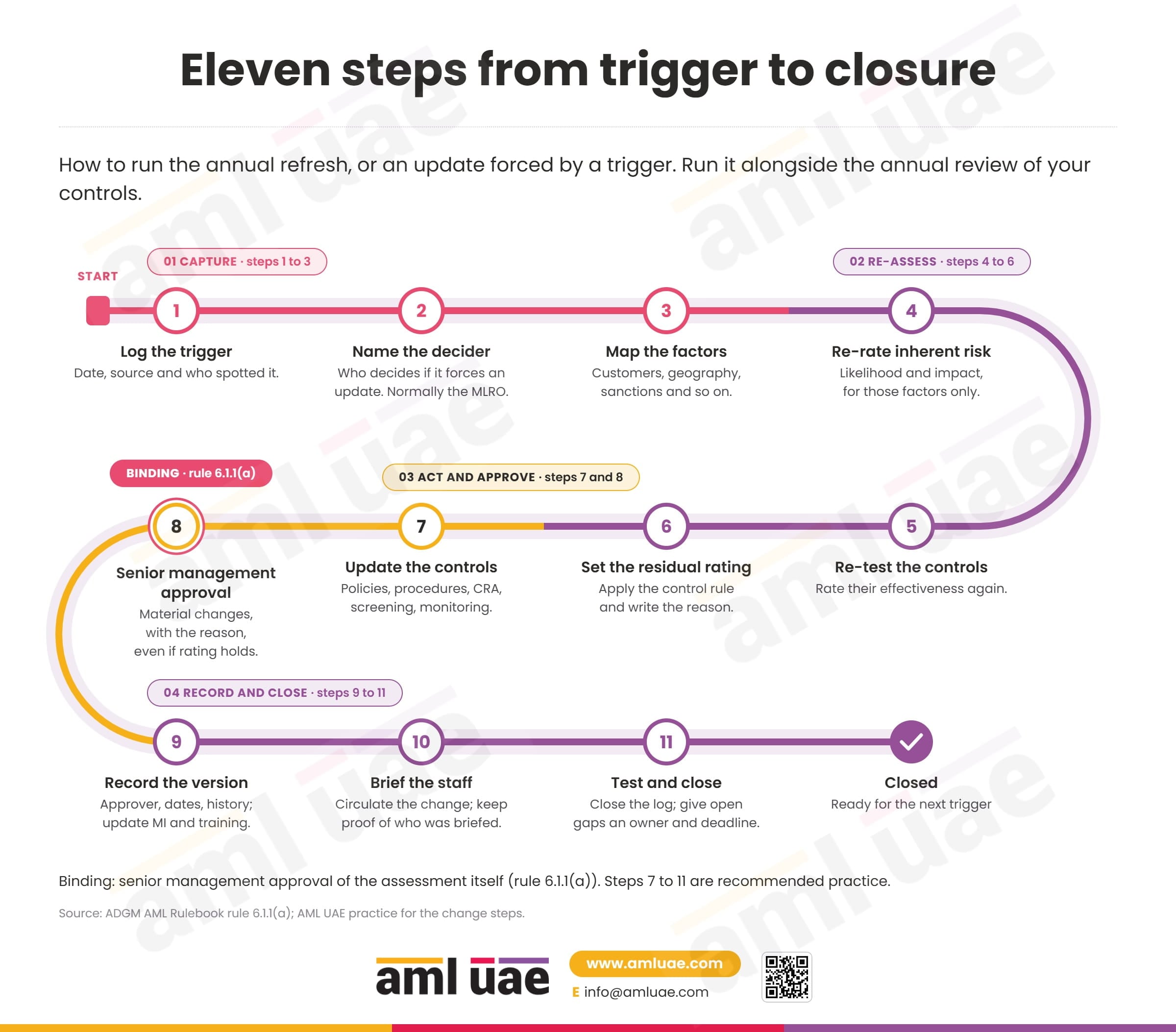
How do you run the annual business risk assessment refresh?
Keep a trigger register. Log each event, the date, who decided whether it forced an update and what changed. Run the yearly refresh together with the separate annual review of how well your controls work, because that review must take the assessment into account.
From trigger to closure, our practice is eleven steps:
- Log the trigger with its date, source and who spotted it.
- Name who decides whether it forces an update. That is normally the MLRO.
- List the factors it touches, such as customers, geography or sanctions.
- Re-rate inherent likelihood and impact for those factors only.
- Re-test the controls that answer them and rate their effectiveness again.
- Apply the control rule to set the new residual rating, and write the reason.
- Update the affected policies, procedures, customer risk assessment method, screening and monitoring settings and other controls, where they apply.
- Send any material change to the assessment, a policy or a control to senior management for approval, with the reason. Do this even when the numerical rating does not move.
- Record the approved version, approver, approval date, effective date and change history. Update the traceability map, management information and training content.
- Circulate the approved change and brief the affected staff. Keep evidence of what was sent and who completed the briefing.
- Test the implemented changes and keep the results. Then close the log entry with the decision, owner, date and a link to the evidence. Give any unresolved deficiency an owner and a deadline. Record decisions of no change too.
Status : recommended practice for steps 7 to 11. Senior management approval of the assessment itself is a binding requirement (rule 6.1.1(a)); the rulebook does not set these change steps.
A FATF or sanctions list change is a prompt to check your exposure, not an automatic rewrite. Your duties under the NAMLCFTC decision in Notice 40/2026, rule 11.2.1 and the sanctions rules apply from the day of the change, whatever the assessment says.
TIP
Log the decision not to update as well. “We reviewed the new product and the ratings did not change, because…” is evidence of a working process.
What does a yearly business risk assessment rhythm look like?
This is our suggested rhythm, not a rule.
| When | What | Evidence |
|---|---|---|
| Through the year | Log each trigger event and the decision | Trigger register |
| Before each launch or change | Short assessment of the new risk | Dated note in the register |
| Once a year | Refresh data, ratings and control testing, together with the annual controls review | New dated version |
| After the refresh | Senior management approval and version log update | Approval minute |
| After national or sector updates | Note what changed and whether it affects your ratings | Register entry |
Who approves the ADGM business risk assessment, and what evidence should you keep?
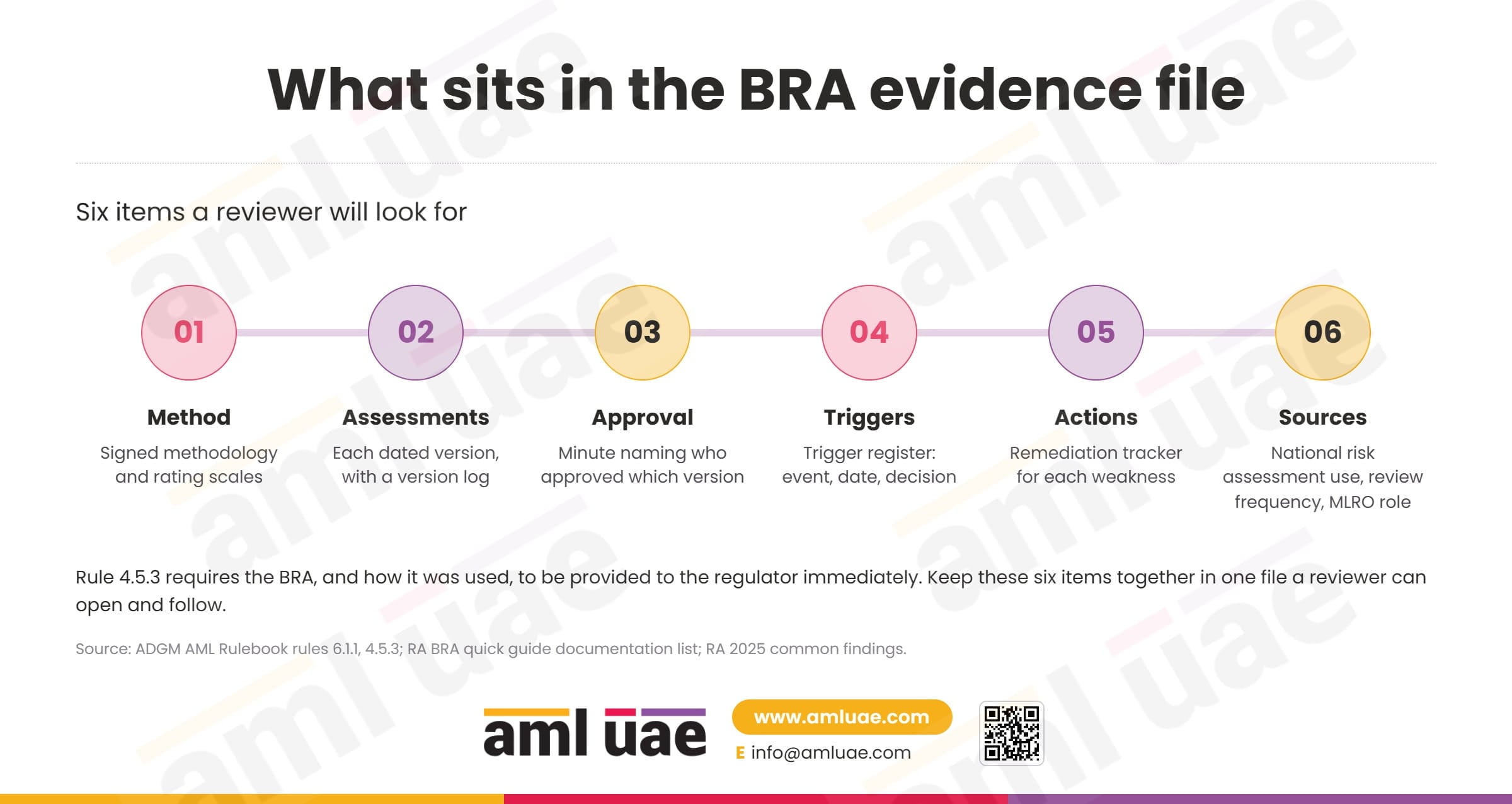
Senior management must approve the business risk assessment, and the MLRO or Compliance Officer normally prepares and maintains it. Keep one evidence file with the method, each dated version, the approval record, the trigger register, the action tracker and the sources used.
Rule 4.5.3(a) and (b) require you to document the business risk assessment and how you used it, and to provide both to the regulator immediately, so keep the evidence file ready to hand over at once. Set retention dates by record type and triggering event. The ADGM six-year rule and the federal five-year rules run from different events, so where they overlap apply both and keep the record until the later date. Neither rule names a fixed period for the assessment itself, so we suggest keeping each approved version and its evidence for at least six years after it is replaced (our practice).
Status : binding requirement to have senior management approve the assessment (rule 6.1.1(a)) and to document it and how you used it, and provide both to the regulator immediately (rule 4.5.3). The contents of the evidence file and the six-year suggestion are recommended practice.
Who does what on the business risk assessment?
Senior management approves, the MLRO or Compliance Officer runs the assessment and each business line supplies data and acts on the results. The roles are:
- Senior management or the board: approves each version and oversees the result.
- MLRO or Compliance Officer: conducts and maintains the assessment and explains how it is used in onboarding, monitoring and escalation.
- Business owners: supply the data on customers, products and channels.
- Internal audit or an independent reviewer: tests that the assessment is followed and works.
What goes in the business risk assessment evidence file?
Keep the signed method, each dated version, the approval minute, the trigger register, remediation actions and the sources you used, so a reviewer can follow the thread. The file holds:
- the signed method
- each dated assessment, with a version log
- the approval minute, naming who approved which version
- the trigger register
- the remediation tracker for any weakness found
- the sources used, including how the latest national risk assessment was taken into account
CHECKLIST
- Current approved version
- Version log with dates
- Approval minute
- Trigger register
- Control test results
- Sanctions component
- Note on national risk assessment inputs
What will a regulator ask to see about your business risk assessment?
A regulator will ask for the current approved version, proof of approval, how you used it and where sanctions risk sits. Have each answer ready, as set out below.
| The ask | What to hand over | Why it matters |
|---|---|---|
| "Show us your assessment" | The current approved version | You must be able to provide it immediately |
| "How did you use it?" | A map from risks to policies, controls and customer ratings | Shows it shaped your controls |
| "Who approved it, and when?" | Approval minute and version log | Senior management approval is required |
| "How do you keep it current?" | Trigger register and the last annual review | It must be kept up to date and reviewed yearly |
| "Where are sanctions, terrorist financing and proliferation financing?" | The separate component with its own rating | Expected as a clearly identifiable part |
| "Which national inputs did you use?" | A note of the national risk assessment and sector ratings, with your own justification | National outcomes must be taken into account |
| "How do you know the controls work?" | Test results and audit findings | Feeds the annual effectiveness review |
What can technology do for the business risk assessment?
Technology can hold the evidence and do the counting, but a named person has to own every rating and every decision. A BRA register with version history and a link to the action tracker keeps the evidence together, and a locked, versioned spreadsheet is enough. Software cannot decide your risk appetite for you.
| Use | What technology can do | What stays with a person |
|---|---|---|
| Register of ratings and versions | Holds each dated version, the approval and the link to the action tracker | The MLRO owns the content. Senior management approves each version |
| Data for the factors | Pulls customer, country, product and transaction counts into one place | Each data owner confirms the data is complete and the counts are right |
| Screening and monitoring output | Shows coverage, alert volumes and ageing as inputs to control testing | Compliance decides whether the control works and what the result means for the rating |
| Dashboards and alerts | Flags a breached appetite limit or a trigger due for review | Senior management sets the limits. The MLRO decides whether to escalate or update |
| Scoring, overrides and access | Applies scoring formulas that are locked and tested, limits who can change them, and keeps an audit trail of who changed what and when | A named owner approves each formula change and each manual override, and the reason is recorded. Compliance validates the calculations and re-tests after any material system or methodology change |
| Drafting and AI tools | Can produce a first draft or summarise a source | A named person checks every fact, rating and reason before use, and the firm stays accountable. Assess a new tool's own risk before you use it (rule 6.1.4) |
“Version control is the unglamorous point that catches firms out. An assessment with no approval date, no approver and no change history looks the same as one nobody read. Put the date, the approver and what changed on the cover page and keep the old versions.”
Where have ADGM firms gone wrong with the business risk assessment?
Three FSRA Final Notices show how a business risk assessment fails: it was missing, incomplete or out of date. None found that the firm engaged in money laundering, and none of the penalties is a BRA-only figure. They work as a checklist of what the regulator looks for.
We have not named the firms. You can read each published notice: Case 1 (24 November 2025), Case 2 (26 August 2025) and Case 3 (27 September 2023).
For scale, the federal fine range is AED 10,000 to AED 5,000,000 per violation (FDL 10/2025, Article 17(1)(b)). The USD figures in the cases are the FSRA’s own penalties in each notice.
Status : supervisory expectation (findings).
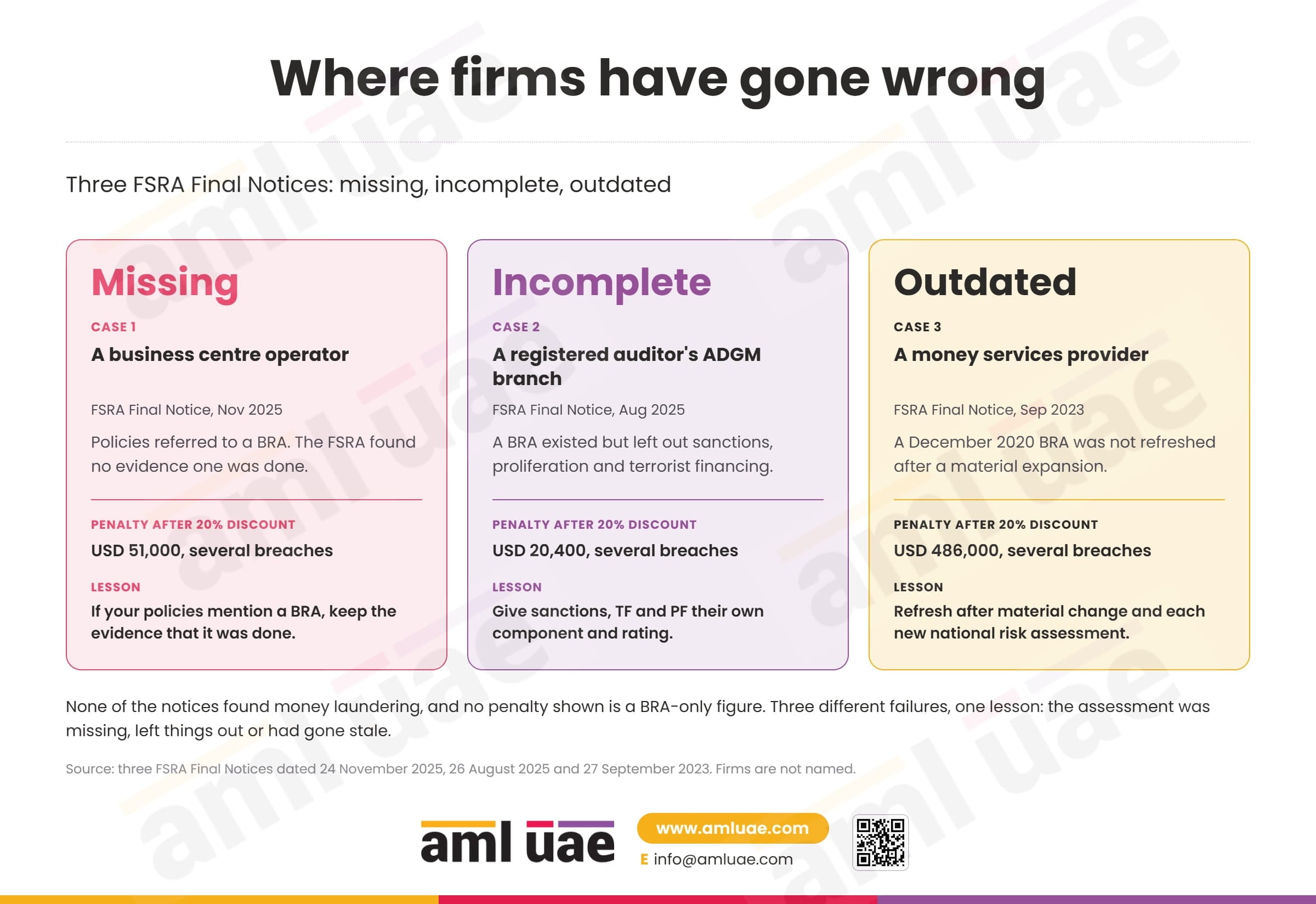
Case 1. A business centre operator (24 November 2025): no evidenced business risk assessment
The firm’s policies referred to a business risk assessment, but the FSRA found no evidence it had done one. Penalty: USD 51,000 after a 20% early settlement discount, covering several breaches.
Case 2. A registered auditor's ADGM branch (26 August 2025): an incomplete business risk assessment
The ADGM branch had an assessment, but it did not assess exposure to targeted financial sanctions, proliferation financing or terrorist financing. Penalty: USD 20,400 after a 20% early settlement discount, covering several breaches.
Case 3. A money services provider (27 September 2023): an outdated business risk assessment
The firm had not refreshed its December 2020 assessment after a material expansion, and it did not reflect the updated UAE national risk assessment. The FSRA said its review did not identify actual money laundering. Penalty: USD 486,000 after a 20% early settlement discount, covering several breaches and unauthorised insurance intermediation.
From our work: what we changed when we rebuilt an ADGM corporate service provider's business risk assessment
We rebuilt the business risk assessment of a small ADGM corporate service provider whose existing document was a template with no data behind it and a single Low rating. We rated each risk from the firm’s own data, tested its controls, compared the result with its risk appetite and recorded senior management approval.
We have anonymised the firm and left out anything that could identify it. Each finding below was met by a specific step and gave the firm a specific result.
| What we found | What we did | What it gave the firm |
|---|---|---|
| The assessment was a template with no data behind it. Controls were named but not shown to work. | Mapped the business in detail: services, clients, covered activities, geographies, delivery channels, technology, fraud and other risks. Used the firm's own customer, service, geography and channel data to quantify each risk. Tested the existing controls on a sample. | Ratings that rest on the firm's own data, and a clear view of which controls work and which do not. |
| Risk factors were described broadly, not identified and rated one by one. The firm carried a single Low rating. | Identified each risk and rated likelihood and impact to reach inherent risk. Rated every factor, then reached residual risk after the tested controls. | A rating for each factor, and an overall rating that reflects the firm's actual exposure. |
| Sanctions, terrorist financing and proliferation financing were not assessed as their own component. | Assessed them as a separate component. Cross-checked the national risk assessment, sector information, red flags from the compliance officer and typologies shared by the FIU. | A separate, visible component that a reader or reviewer can trace. |
| No senior management approval, version history or approval trail. | Documented the whole method, obtained senior management approval and filed the data behind every rating in an evidence file. | Approval recorded, with a version and evidence trail. |
| Beyond the findings: the assessment had no link to appetite, controls or policy. | Compared residual risk with the risk appetite and recommended further controls where it was outside. Aligned the result with the policies and procedures manual and the customer risk assessment. | A written risk appetite, additional controls where needed, and one consistent line from assessment to policy to customer rating. |
What changed
- The firm’s ratings now reflect its real risk exposure, and its risk appetite is written down.
- It knows which controls work, and sanctions, terrorist financing and proliferation financing risk is assessed and visible on its own.
- Senior management approval, versions and the evidence behind each rating are recorded.
FROM OUR WORK
The lesson. A longer document was not what helped. What helped was a clear line from each risk to the control that answers it, and from the assessment to the policies and the customer risk assessment, with a record of who agreed each step and when
Status : our own work, anonymised. It describes our review and what we changed, and carries no regulator conclusion.
“When a business risk assessment fails, it rarely fails on length. It fails on connection. Sanctions, terrorist financing and proliferation financing are folded into a general paragraph, or the controls never mention the risks above them. A reader should be able to follow one risk from the assessment to a named control and then to the evidence.”
How do you test that your ADGM business risk assessment works?
An assessment works if it is documented, current, approved and actually changes your controls. Test it with four questions: was the method followed, is the data behind the ratings real, did senior management approve the version in force, and did the result change the customer risk ratings and controls.
Status : recommended practice.
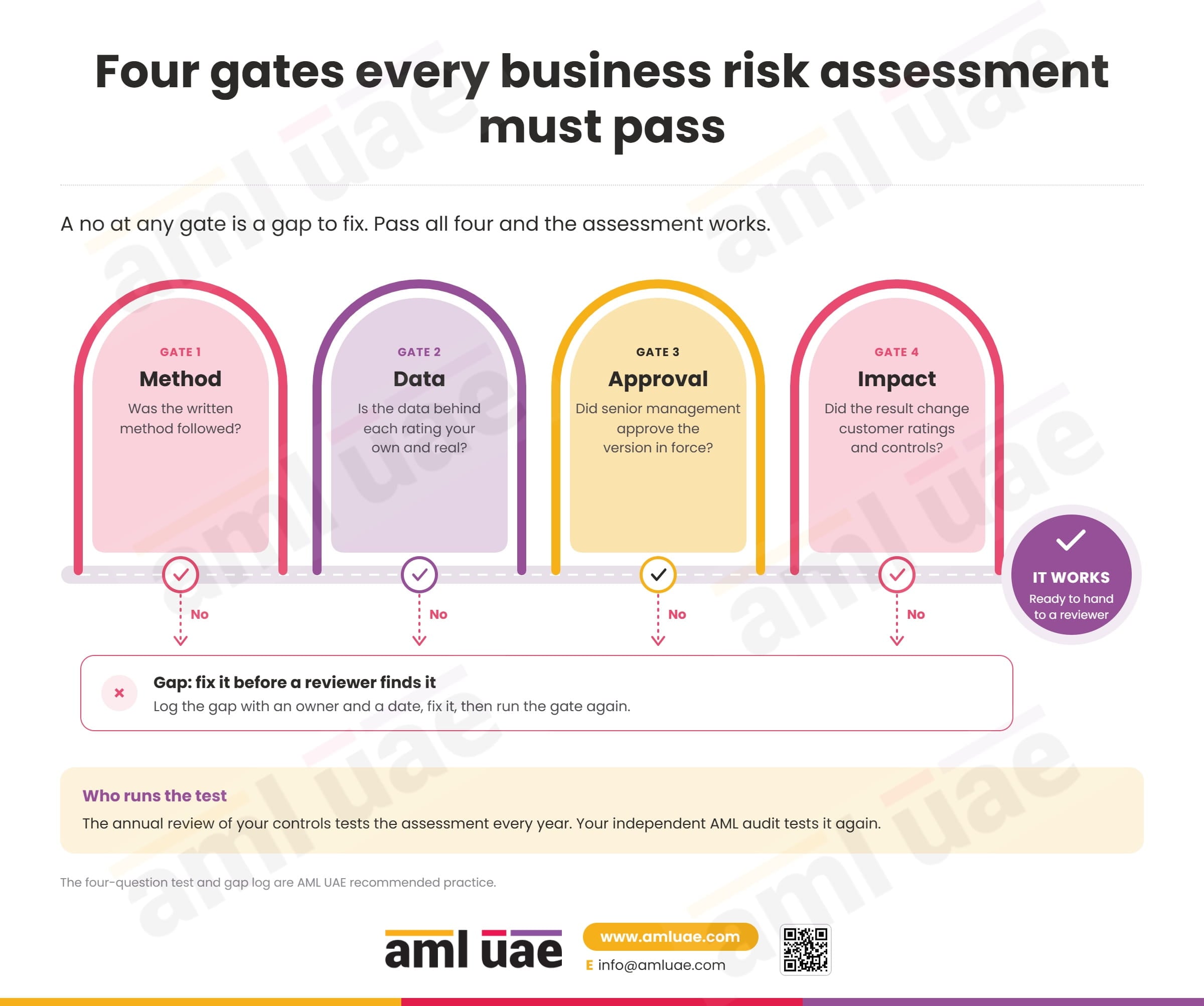
What will a reviewer look at in your business risk assessment?
If the answer to the fourth gate, impact, is no, the assessment is decorative. The annual review of your controls should test it, and so should your independent audit. Our guide to the independent AML audit explains what that review covers.
What does a weak business risk assessment look like?
The FSRA’s review of virtual asset firms describes it: generic content, missing risk factors, no clear method and no link to the controls.
Self-test: twelve questions on your business risk assessment
Answer yes or no. Every no is a gap to fix before a reviewer finds it.
- Is your method written down, with the scales and who approves?
- Does the assessment cover customers, countries, products, channels, transactions and technology?
- Are sanctions, terrorist financing and proliferation financing shown as their own component?
- Does every rating have a written reason in your own words?
- Is it based on your own data, not only sector averages?
- Did senior management approve the version in force, and is that recorded?
- Is there a version log and a trigger register?
- Did you take the latest national risk assessment into account and note how?
- Do your customer risk ratings and controls trace back to it?
- Has senior management approved a risk appetite that covers money laundering, terrorist financing and proliferation financing separately?
- Do your management reports measure against that appetite?
- Could you hand the assessment and the evidence to the regulator today?
Frequently asked questions about the ADGM business risk assessment
These are the fifteen questions firms ask most about the ADGM business risk assessment, answered in a few lines each. In short: if the ADGM rules cover your firm you need one, it must be approved by senior management, kept current and backed by evidence, and the sanctions component must stand apart from the rest.
Is a business risk assessment mandatory in ADGM?
Yes. The ADGM AML Rulebook requires it from Authorised Persons (other than Credit Rating Agencies), Recognised Bodies, Representative Offices and DNFBPs. Federal law adds the same duty on top, for financial institutions, DNFBPs and virtual asset service providers.
How often must the business risk assessment be updated?
Keep it up to date on an ongoing basis. The FSRA expects a review at least once a year and whenever something material changes. The separate annual review of how well your controls work is a binding duty and must take the assessment into account.
Who must approve the business risk assessment?
Senior management. The FSRA also expects a formal record of approval.
What is the difference between the business risk assessment and the customer risk assessment?
The BRA assesses your own business. The customer risk assessment assesses each customer. The BRA result feeds each customer rating.
Must sanctions, terrorist financing and proliferation financing be assessed separately in the business risk assessment?
They must be inside the assessment. The FSRA and the RA both expect them as a clearly identifiable component, as the guidance under rule 6.1.5 says.
Must the business risk assessment cover fraud and cyber risk?
Yes, as a supervisory expectation. The guidance under ADGM AML rule 6.1.5 says the business risk assessment should assess your exposure to other financial crime, such as fraud and the theft of personal data, and to cyber security risk. Rate them as factors alongside money laundering, in proportion to your business.
Can a consultant or outsourced MLRO prepare the business risk assessment?
In practice yes, but responsibility stays with the firm. Rule 6.1.1 requires your own senior management to approve the assessment, so the duty cannot be handed over.
Does the business risk assessment need an independent audit?
Federal law requires an independent audit function for every financial institution, DNFBP and virtual asset provider. Banks and other Authorised Persons have an ADGM internal audit rule on top. For a DNFBP the federal duty is the source of the audit requirement. The ADGM rulebook also lets the annual review of controls be done internally, by internal audit or compliance, or by an independent firm. See our guide to the independent AML audit.
Does a small firm need a full business risk assessment?
Yes, but it can be proportionate. The rule links the assessment to the nature, size and complexity of your activities, so a small firm can have a shorter document. It still needs the factors, the sanctions component, senior management approval and the evidence.
Is a template enough for a business risk assessment?
No. A template is a starting point. Regulators have flagged assessments that are generic or disconnected from the controls, so your own data and written reasons are what make it yours.
How long should the business risk assessment be?
There is no required length. It should be specific enough that a reviewer can follow each rating from your data to your controls.
What happens if a firm has no business risk assessment, or a weak one?
Supervisors can fine a firm AED 10,000 to AED 5,000,000 per violation under federal law and can restrict or suspend activity. In Case 1 above, a missing assessment was treated as a breach alongside other failures.
What is a risk appetite, and does ADGM require one?
A risk appetite is a statement of how much money laundering, terrorist financing and proliferation financing risk a firm will accept. The ADGM AML Rulebook does not use the term. The Registration Authority’s 2024 thematic review treats an approved appetite, linked to the business risk assessment, as good practice, and asks larger firms to consider one.
How do you operationalise the ADGM business risk assessment?
Give it owners, report against it on one page each quarter, brief staff on the top risks, link it to customer ratings and the new product check, and refresh it on a calendar. The test is whether it changes what people do between annual reviews.
Is there a template?
Yes. See our BRA template for DNFBPs. ADGM firms should add a version log and a trigger register, as set out in the sections on updating and evidence.
How AML UAE can help with your ADGM business risk assessment
AML UAE helps ADGM banks, financial firms and DNFBPs build and refresh their assessment. Our business risk assessment service delivers a documented method, reasoned ratings, a separate sanctions component and an approval pack, matched to the FSRA guidance and the findings reviewers have reported.
Related guides: how to conduct a business risk assessment; AML guide for ADGM companies; annual AML/CFT risk assessment report.
Legal references and sources for the ADGM business risk assessment
You do not need these to follow the guide, but they are the sources behind it. The table below lists each federal and ADGM provision in plain words, with the type of firm it applies to. Notices and regulator reports follow the table. ADGM rule numbers come from the ADGM AML Rulebook.
| Reference | In plain words | Applies to |
|---|---|---|
| Federal Decree-Law 10/2025, Article 19(1)(a), with Cabinet Resolution 134/2025, Article 5 | Identify, assess, document and keep your risk assessment, and provide it to the supervisor on request | All FIs, DNFBPs and VASPs |
| Cabinet Resolution 134/2025, Article 21 and Article 21(6) | Policies approved by senior management, and an independent audit function that tests them | All FIs, DNFBPs and VASPs |
| Cabinet Resolution 134/2025, Article 24 | Assess risk before launching a new product, practice or technology | All FIs, DNFBPs and VASPs |
| Cabinet Resolution 134/2025, Article 25 | Keep transaction records for at least five years from completion or termination, and customer due diligence and similar records for at least five years from the most recent of the listed events | All FIs, DNFBPs and VASPs |
| Federal Decree-Law 10/2025, Article 17 | Fines of AED 10,000 to AED 5,000,000 per violation, and other sanctions | All FIs, DNFBPs, VASPs and NPOs |
| FSM Regulations 2015, definition of Relevant Person and section 15A(4) | Says who counts as a Relevant Person for the AML chapter and rules: Authorised Persons other than Credit Rating Agencies, Recognised Bodies, DNFBPs, NPOs and anyone the FSRA deems a Relevant Person under section 15A(4) | Everyone the definition names |
| FSM Regulations 2015, section 15B(1) | A Relevant Person must comply with the federal AML legislation as it applies to it in ADGM | Every Relevant Person |
| ADGM AML Rulebook, rule 1.2.1 | Which chapters apply to each type of firm | Every Relevant Person in respect of its activities in or from ADGM. Chapters 1 to 14 apply to Authorised Persons other than Credit Rating Agencies and to Recognised Bodies, chapters 1 to 6 and 11 to 14 to Representative Offices, chapters 1 to 9 and 11 to 15 to DNFBPs, and chapter 16 only to NPOs |
| Rule 6.1.1 | Assess your risks, have senior management approve them, cover the listed factors and mitigate the risks found. Money laundering risk includes terrorist financing, proliferation financing and sanctions breaches | Authorised Persons other than Credit Rating Agencies, Recognised Bodies, Representative Offices and DNFBPs. Not NPOs |
| Rule 6.1.2 | Use the assessment to build controls, understand residual risk, set priorities and carry out customer risk assessments | Authorised Persons other than Credit Rating Agencies, Recognised Bodies, Representative Offices and DNFBPs. Not NPOs. Representative Offices have no customers, so the customer risk assessment part does not apply to them |
| Rules 6.1.3, 6.1.4 and 6.1.5 | Keep it up to date, assess before new products, technology, markets or a change in customer base, and regularly test adequacy. Guidance to rule 6.1.5 adds other financial crime, cyber security, non-face-to-face and eKYC risk, and external update triggers | Authorised Persons other than Credit Rating Agencies, Recognised Bodies, Representative Offices and DNFBPs. Not NPOs |
| Rules 4.1.1(4), 4.1.1(5) and 4.1.2 | Annual review of controls that takes the assessment into account, done internally or by an independent firm, with minimum content | Authorised Persons other than Credit Rating Agencies, Recognised Bodies, Representative Offices and DNFBPs. Not NPOs |
| Rule 4.5.1 | Keep the listed records for at least six years from the last of the listed events. The list does not name the business risk assessment itself | Authorised Persons other than Credit Rating Agencies, Recognised Bodies, Representative Offices and DNFBPs. Not NPOs |
| Rule 4.5.3 | Document the assessment and how you used it, and provide both to the regulator immediately | Authorised Persons other than Credit Rating Agencies, Recognised Bodies, Representative Offices and DNFBPs. Not NPOs |
| Rule 10.4.1 | Internal audit of the AML framework | Authorised Persons other than Credit Rating Agencies, and Recognised Bodies, only |
| Rule 11.2.1 | Stay informed of findings, recommendations and sanctions from the UN Security Council, FATF, EOCN, NAMLCFTC, FSRA and others, and take reasonable measures to comply. It feeds the update triggers in this guide | Authorised Persons other than Credit Rating Agencies, Recognised Bodies, Representative Offices and DNFBPs. Not NPOs |
| FSRA Notice FSRA/FCCP/62/2026 (10 April 2026) | Guidance on how to build and document the assessment, useful for evidence, residual risk and version control. It predates the current rulebook, so cite rule numbers from chapter 6 | Addressed to Approved Persons; reminds all Relevant Persons, including DNFBPs |
| FSRA Notice FSRA/FCCP/37/2025 (25 April 2025) | Circulated the updated UAE national ML/TF risk assessment | Addressed to ADGM firms |
| FSRA Notice FSRA/FCCP/91/2026 (1 June 2026) | Informs firms of the 2026 legal persons and arrangements risk assessment and encourages them to consider it. It requires no action | Addressed to SEOs and MLROs; informs all Relevant Persons |
| FSRA Notice FSRA/FCCP/40/2026 (6 March 2026) | Circulates NAMLCFTC decision 12 of 2026 on the FATF high-risk and increased monitoring lists. Firms review the lists regularly, take them into account and apply the stated counter-measures. It is a decision circulated by the FSRA, not an ADGM rule | Addressed to SEOs and MLROs; the decision covers FIs, DNFBPs, VASPs and NPOs |
Share via :
Share via :
About the Author

Pathik Shah
FCA, CAMS, CISA, CS, DISA (ICAI), FAFP (ICAI)
Pathik is an ACAMS-certified AML consultant specialising in governance, risk, and compliance for regulated entities in the UAE. He brings over 28 years of experience, with 1,000+ hours of AML training and 200+ advisory engagements across DNFBPs, VASPs, and FIs. He supports businesses in aligning with AML/CFT requirements from the CBUAE, DFSA, MoET, MoJ, VARA, CMA, FSRA, and FATF. Known for translating complex regulations into audit-ready procedures, Pathik enables operational clarity and compliance readiness.

Reach Out to Pathik