



Local Terrorist List
Published On: 04/21/2026
Protect your business with reliable and effective AML strategies with AML UAE.
Last Reviewed On: 07/22/2026 | Last Updated On: 07/22/2026
Local Terrorist List: Compliance Guide for FIs, DNFBPs and VASPs
Quick Overview
The UAE Local Terrorist List is the national list of designated terrorist individuals, entities and groups issued by the UAE Cabinet on the proposal of the Supreme Council for National Security, in accordance with UNSCR 1373 (2001), Federal Law No. 7 of 2014 and Cabinet Decision No. 74 of 2020. Financial institutions, DNFBPs and VASPs in the UAE must screen customers, potential customers, beneficial owners and transactions against the UAE Local Terrorist List on an ongoing and risk-based basis, freeze any funds and prohibit services without delay (within 24 hours of designation), notify the Supervisory Authority and the Executive Office within two business days, and file a Confirmed Name Match Report (CNMR) or Partial Name Match Report (PNMR) through goAML within five business days.
Sources : This article draws on the UAE Executive Office for Control and Non-Proliferation (EOCN) ‘UN page’ and TFS Guidance, Cabinet Decision No. 74 of 2020, Federal Law No. 7 of 2014 (as amended by Federal Law No. 4 of 2024), Federal Decree-Law No. 10 of 2025, and Cabinet Resolution No. 134 of 2025.
Key Takeaways for UAE Regulated Entities
- The UAE Local Terrorist List is the UAE’s domestic terrorist list, distinct from the UN Consolidated List, but both are part of the UAE TFS framework that Reporting Entities must screen and implement.
- It is issued by the UAE Cabinet on the proposal of the Supreme Council for National Security (SCNS), in accordance with UNSCR 1373 (2001) and Article 63(1) of Federal Law No. 7 of 2014.
- The operational TFS framework is set by Cabinet Decision No. 74 of 2020, which treats the UAE Local Terrorist List and the UN Consolidated List together as the ‘Sanctions Lists’ that Reporting Entities must screen against.
- Reporting Entities must register with the Executive Office and goAML, screen on an ongoing basis, freeze within 24 hours of designation, and report through CNMR, PNMR and STR/SAR workflows.
- Non-compliance can attract criminal penalties under Article 33 of Federal Decree-Law No. 10 of 2025 (imprisonment and a fine of not less than AED 20,000, or either penalty), administrative fines of AED 10,000 to AED 5 million per violation under Article 17, and corporate fines of up to AED 100 million for core offences.
What Is the UAE Local Terrorist List?
The UAE Local Terrorist List is the national sanctions list of individuals, entities and groups designated by the UAE Cabinet as terrorists, terrorist organisations or groups. It sits alongside the UN Consolidated List, and both are part of the UAE TFS framework that Reporting Entities must screen and implement under Cabinet Decision No. 74 of 2020.
The Local List is the UAE’s implementation of UNSCR 1373 (2001), which calls on every UN member state to identify and designate individuals, entities and groups suspected of, attempting to or committing terrorist acts, and to apply freezing measures to them. Unlike the UN Consolidated List, which is compiled by UNSC Sanctions Committees, the UAE Local Terrorist List is a purely domestic instrument.
UAE Local Terrorist List vs UN Consolidated List
| Feature | UAE Local Terrorist List | UN Consolidated List |
| Legal Basis | UNSCR 1373 (2001); Federal Law No. 7 of 2014 (Article 63(1)); Cabinet Decision No. 74 of 2020. | UNSCRs adopted under Chapter VII of the UN Charter (for example, 1267/1989/2253, 1988, 1718). |
| Designating Authority | UAE Cabinet, on the proposal of the Supreme Council for National Security (SCNS). | UNSC and its Sanctions Committees. |
| Scope | Domestic: individuals, entities and groups meeting the UNSCR 1373 designation criteria. | International: persons and entities linked to specified UN sanctions regimes. |
| Where Published | EOCN website (PDF and Excel) and the UAE Official Gazette. | Official UNSC website; circulated by the EOCN in the UAE. |
| UAE TFS Obligation | Yes, under Cabinet Decision No. 74 of 2020. | Yes, under Cabinet Decision No. 74 of 2020. |
Legal Framework Behind the UAE Local Terrorist List
The Local Terrorist List operates within a layered legal framework combining counter-terrorism law, AML/CFT/CPF law and sanctions-implementation regulations.
- UNSCR 1373 (2001) is the international anchor, obliging every UN member state to prevent and suppress the financing of terrorist acts, criminalise terrorist financing and apply freezing measures to designated persons.
- Federal Law No. 7 of 2014 on Combating Terrorism Offences (as amended by Federal Law No. 4 of 2024) is the UAE’s core counter-terrorism law. Article 63(1) empowers the Cabinet to issue and maintain the Local Terrorist List.
- Cabinet Decision No. 74 of 2020 on the Terrorism Lists Regulation and the Implementation of UN Security Council Resolutions sets out how TFS must be applied to persons designated on the Local Terrorist List and the UN Consolidated List.
- Federal Decree-Law No. 10 of 2025 on Combating Money Laundering, the Financing of Terrorism and the Financing of Proliferation (effective 14 October 2025) provides the broader AML/CFT/CPF legal framework, including expanded offences, stricter supervisory powers and enhanced penalties.
- Cabinet Resolution No. 134 of 2025 provides the Executive Regulations to the 2025 AML Law and replaced Cabinet Decision No. 10 of 2019 with effect from 14 December 2025.
- EOCN Guidance on Targeted Financial Sanctions (updated July 2025) sets the operational expectations for screening, freezing and goAML reporting by Reporting Entities.
Accessing the UAE Local Terrorist List
Reporting Entities should treat the EOCN as the single authoritative source for the current UAE Local Terrorist List. Reliance on third-party or vendor screening lists alone is not sufficient.
Where the List Is Published
- The current UAE Local Terrorist List is published on the EOCN website (www.uaeiec.gov.ae), in PDF and Excel formats, and is accessible from the Sanctions Implementation webpage.
- The UN Consolidated List is published on the official UNSC website and is circulated in the UAE by the EOCN alongside Local List updates.
- Listing and de-listing decisions for the Local Terrorist List are also published through the UAE Official Gazette.
Subscribing to Updates via the EOCN Notification Alert System
Reporting Entities are required, under Article 21 of Cabinet Decision No. 74 of 2020, to register on the EOCN Notification Alert System (NAS) to receive automated email notifications of new listings, re-listings, updates and de-listings for the Local Terrorist List and the UN Consolidated List. This registration is separate from goAML registration and is essential to enable immediate re-screening when the lists change.
Vendor Screening Tools Are Not a Substitute
Many Reporting Entities rely on third-party vendor lists for sanctions screening. CBUAE guidance is clear that such external services are useful but should not be viewed as an absolute guarantee of compliance. It is the Reporting Entity’s responsibility to undertake due diligence on vendors and to ensure that vendor lists fully reflect the current UAE Local Terrorist List and UN Consolidated List as published by the EOCN and the UNSC. Where there is any discrepancy, the official EOCN and UNSC sources take precedence.
How Designations Are Made on the UAE Local Terrorist List
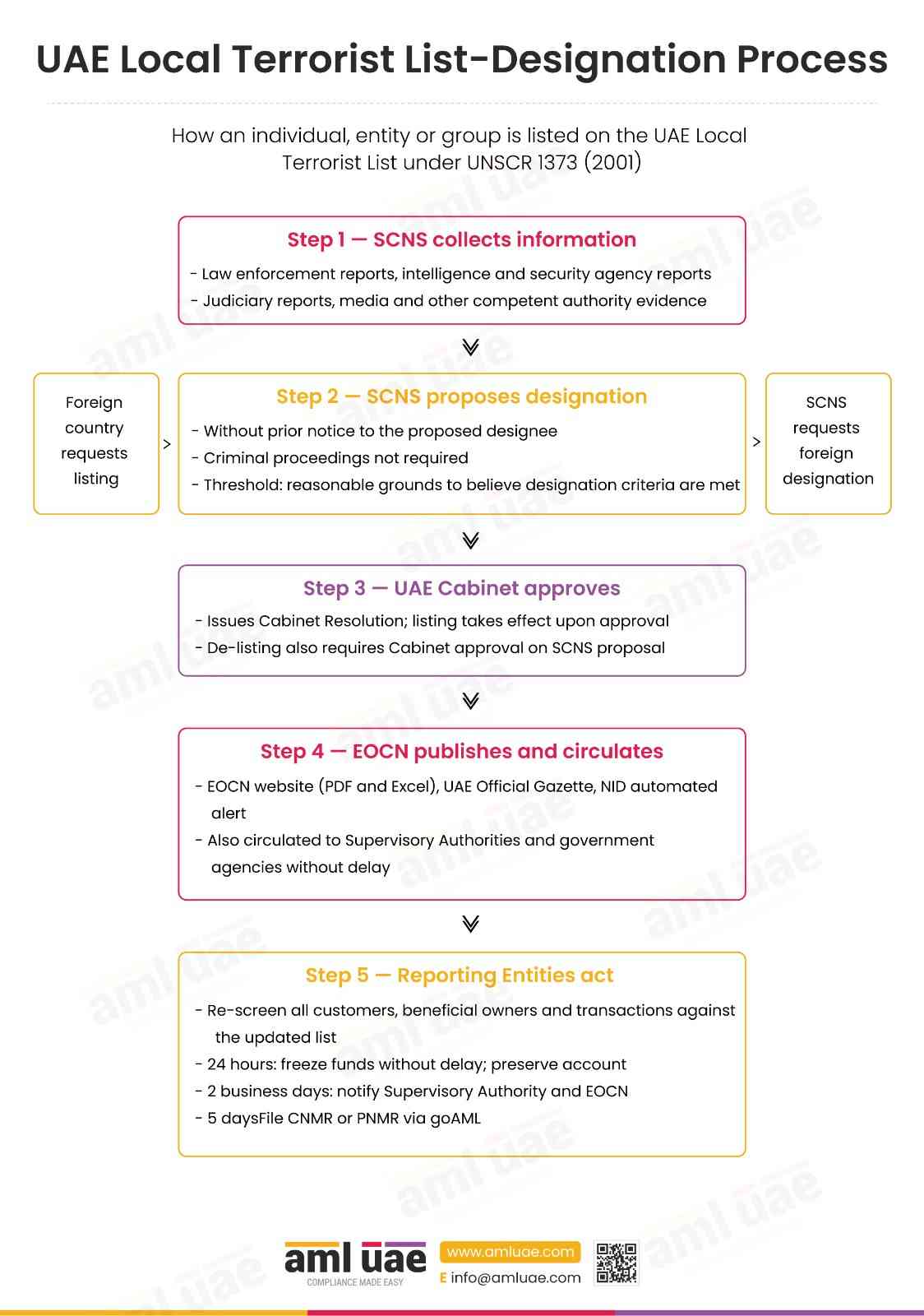
The Local Terrorist List is maintained through a defined proposal-and-approval process described in Cabinet Decision No. 74 of 2020 and the EOCN ‘UN page’. The Supreme Council for National Security acts as the national designating authority at the proposal stage, and the UAE Cabinet acts as the approving authority.
Step-by-Step Designation Process
Step | Actor | Action |
1 | Supreme Council for National Security (SCNS) | The SCNS collects information on a proposed designee from law enforcement authorities and other competent agencies, and assesses whether the person or organisation meets the designation criteria under UNSCR 1373 (2001). |
2 | SCNS | If the SCNS is satisfied that there are reasonable grounds to believe the designation criteria are met, it proposes the designation, with or without prior notice, and irrespective of whether criminal proceedings exist. |
3 | UAE Cabinet | The Cabinet considers the proposal and, if approved, issues a resolution designating the individual, entity or group on the Local Terrorist List. |
4 | Executive Office (EOCN) | The Executive Office publishes the updated Local Terrorist List on the EOCN website, circulates the update via the Notification Alert System, and coordinates implementation with Supervisory Authorities. |
5 | Reporting Entities | FIs, DNFBPs and VASPs immediately screen customers, beneficial owners and transactions against the update, freeze any match within 24 hours, notify the Supervisory Authority and the Executive Office within two business days, and file the relevant CNMR or PNMR through goAML within five business days. |
Foreign-Origin and Outgoing Requests
Foreign-originating requests: A foreign country may request the SCNS to include an individual, entity or group on the Local Terrorist List where the proposed designee meets the UNSCR 1373 designation criteria. The SCNS assesses the request and, if satisfied, presents it to the UAE Cabinet for consideration.
Outgoing requests: The SCNS may unilaterally request another state to designate or apply freezing measures to an individual or entity that meets the UNSCR 1373 designation criteria, communicating through diplomatic or approved security channels. It may also propose designations to the UN Sanctions Committees under UNSCRs 1267, 1988, 1989, 2253 and others.
Supporting Information in a Listing Proposal
A Local List designation proposal typically includes:
- Specific information that establishes links between the proposed designee and terrorist individuals, entities, groups or activities, or otherwise establishes that the proposed designee meets the UNSCR 1373 designation criteria.
- Evidence or documents supporting the proposal, such as reports of law enforcement authorities, intelligence agencies, the judiciary or other competent bodies.
- Personal and identifying information sufficient to enable accurate identification of the proposed designee.
- Data on assets, activities, affiliations and other factors relevant to determining the scope of TFS measures to be applied.
Periodic Review and De-Listing of the UAE Local Terrorist List
The SCNS conducts periodic reviews of the Local Terrorist List in coordination with the Ministry of Justice and based on information from law enforcement authorities and other relevant UAE agencies. If the SCNS considers that there are no longer reasonable grounds to believe that a listed individual, entity or group meets the designation criteria, it proposes de-listing.
De-listing takes effect only after the UAE Cabinet approves the SCNS proposal. Once de-listing is announced, the obligation to freeze funds and prohibit services in relation to that person ceases, and Reporting Entities may lift freezing measures only once they have verified the de-listing through the EOCN’s official channels.
Grievances Against Listing
Cabinet Decision No. 74 of 2020 provides mechanisms for listed persons and affected third parties to seek redress.
- Grievance against a Local List designation: A listed individual or entity, their legal representative, or any stakeholder may submit a written application for grievance to the Executive Office, accompanied by supporting documents. The Executive Office refers the application to the SCNS, which considers it in line with the relevant procedures.
- Request by similarly-named persons: Any individual or entity with a name identical or similar to a listed name, and any person adversely affected by a freezing measure, may submit a written application to the Executive Office for de-freezing or cancellation of the measure. The Supreme Council is required to issue its decision within 30 days of receipt.
- Use of frozen funds: Listed persons or their legal representatives may apply through the Executive Office for permission to use part of the frozen funds for necessary or basic expenses (for example, food, rent, mortgage, medicine, education or legal fees), subject to Ministry of Justice approval and Supreme Council coordination.
TFS Obligations for FIs, DNFBPs and VASPs
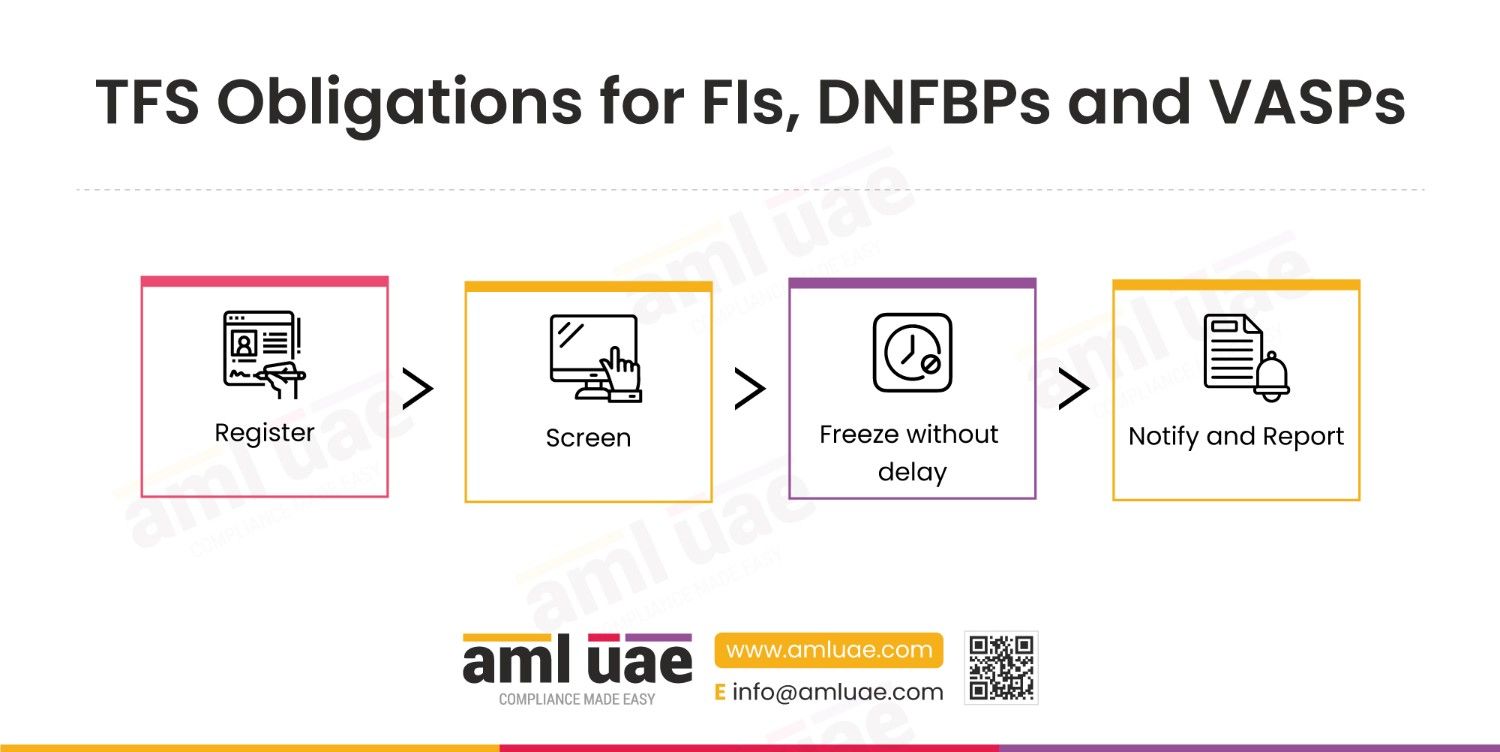
Article 21 of Cabinet Decision No. 74 of 2020 imposes four core TFS obligations on Reporting Entities. These apply to the UAE Local Terrorist List and the UN Consolidated List equally.
Obligation | Requirement |
1. Register | Register on the EOCN Notification Alert System (NAS) to receive automated email notifications of listing, re-listing, updating and de-listing decisions on the Local Terrorist List and the UN Consolidated List. Register separately on goAML to file TFS reports. |
2. Screen | Screen customers, potential customers, beneficial owners and transactions against the UAE Local Terrorist List and the UN Consolidated List on an ongoing and risk-based basis. This includes daily list checks, onboarding screening, transaction screening, periodic KYC review and immediate re-screening on any list update. Screening procedures must remain active on weekends and public holidays where business activity or access to funds is possible. |
3. Freeze without delay | On a confirmed match, freeze all funds and assets owned or controlled, directly or indirectly, by the designated person, and prohibit the provision of funds or services. ‘Without delay’ is defined in Article 1 of Cabinet Decision 74 of 2020 as immediately, or in any case within 24 hours of the listing decision being issued. Institutions should preserve the freeze rather than closing the account, which would not comply with Cabinet Decision No. 74 of 2020. |
4. Notify and Report | Notify the relevant Supervisory Authority and the Executive Office within two business days of taking any freezing measure or identifying an attempted transaction. File a Confirmed Name Match Report (CNMR) or Partial Name Match Report (PNMR) through goAML within five business days, as applicable, with all supporting documents. |
Reporting Entities must also maintain written policies, procedures and internal controls tailored to their risk profile, deliver staff training to prevent tipping-off, and cooperate with the Executive Office and Supervisory Authorities.
UAE Local Terrorist List Screening Requirements
The EOCN’s TFS Guidance makes clear that screening is an ongoing and risk-based exercise, not a periodic tick-box check. In practice, Reporting Entities should embed Local Terrorist List screening into the following moments.
When to Screen
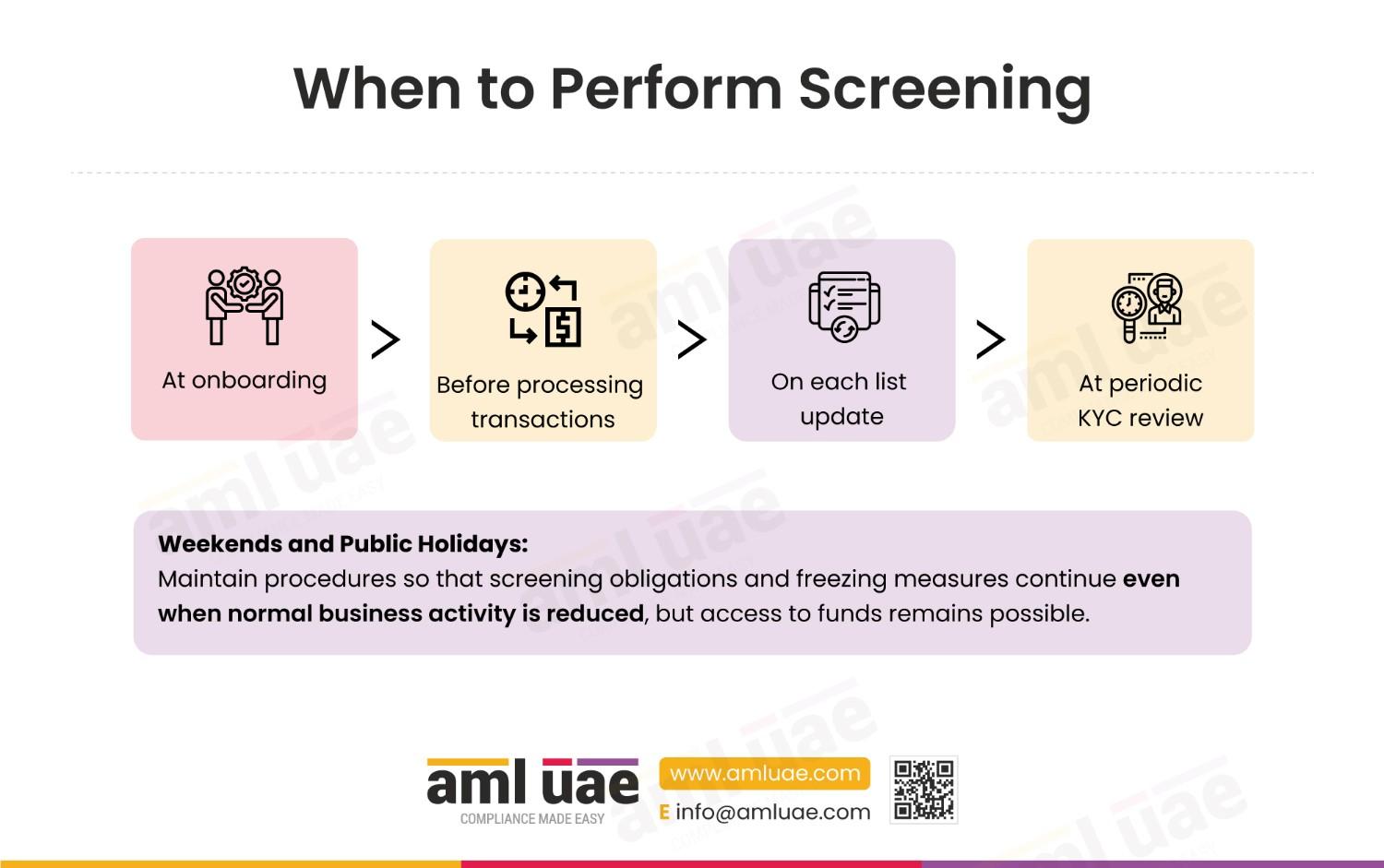
At onboarding: Screen every prospective customer, including connected parties such as directors, authorised signatories and ultimate beneficial owners, against the Local Terrorist List before establishing the business relationship.
Before processing transactions, Screen relevant transaction parties and counterparties (originators, beneficiaries, intermediaries) against the Local Terrorist List before executing the transaction.
On each list update: Immediately re-screen the full customer base and active transactions upon receiving any EOCN notification of a listing, re-listing, update or de-listing decision.
At periodic KYC review: Re-screen at each risk-based periodic review cycle, and upon any material change in customer profile, ownership, control or beneficial ownership.
On weekends and public holidays: Maintain procedures so that screening obligations and freezing measures continue even when normal business activity is reduced, but access to funds remains possible.
What to Screen
- Customer databases, including dormant and closed accounts within any applicable retention period.
- Potential customers undergoing due diligence.
- Beneficial owners at each level of the ownership chain.
- Directors, officers, authorised signatories, agents and other connected parties.
- Transaction originators, beneficiaries, intermediaries and counterparties.
- Virtual asset wallet addresses for VASP obligations.
Current or Former Customer Matches
The EOCN explicitly addresses what happens when a current or former customer is identified as a match. Where a confirmed match is found on an existing customer, the Reporting Entity must freeze all funds and stop providing financial or other services to the customer, and notify the relevant Supervisory Authority and the Executive Office.
Where a former customer or any past transaction is identified as involving a designated person, the Reporting Entity should apply the CNMR workflow in respect of any funds or obligations still under its control, document the historical relationship, and report through goAML as required.
CNMRs can also cover previous business relationships, transactions and accounts held prior to the designation, typically across a five-year timeframe.
Permitted Credits to Frozen Accounts
The EOCN explicitly confirms that frozen accounts may still receive certain credits without breaching the freezing obligation, provided the additions are themselves immediately frozen. These include:
- Interest, profits or other earnings due on the account.
- Payments due under contracts, agreements or obligations concluded or arising before the date on which the individual or legal entity was designated.
Where such credits occur, the Reporting Entity must immediately freeze the additions and notify the relevant Supervisory Authority and the Executive Office. This operational nuance allows institutions to comply with the freezing regime without breaching pre-existing contractual obligations to third parties.
Ownership, Control and Acting on Behalf of a Designated Person
Freezing obligations extend beyond directly listed persons. The EOCN’s ‘UN page’ makes clear that freezing measures apply to any entity directly or indirectly owned or controlled, wholly or jointly, by a designated individual, entity or group, and to any individual or entity acting on behalf of or at the direction of a designated person.
The EOCN’s published position on minority interests is explicit: Reporting Entities should apply freezing measures in cases where a designated person holds a minority interest, if there is evidence that the designated person exerts control over the legal entity despite owning a minority interest. A simple percentage threshold is therefore not a safe test on its own.
In practice, Reporting Entities should assess ownership, control and acting on behalf of together. The EOCN TFS Guidance sets out three tests to apply in combination:
- Majority ownership: an entity is treated as owned where a designated person holds more than 50 per cent of the proprietary rights of the legal entity, directly or indirectly, or has a controlling interest in it.
- Control (including where ownership is below 50 per cent): freezing measures also apply where a designated person exercises control through appointment or removal rights over the management body, majority voting rights under a shareholder agreement, a power of attorney, or other arrangements giving effective direction over the entity.
- Acting on behalf of or at the direction of a designated person: includes authorised signatories, power-of-attorney holders, and representatives acting for a designated person.
In all cases, Reporting Entities should document their ownership and control analysis to demonstrate a defensible position to the Supervisory Authority.
Handling Matches: CNMR, PNMR and STR/SAR
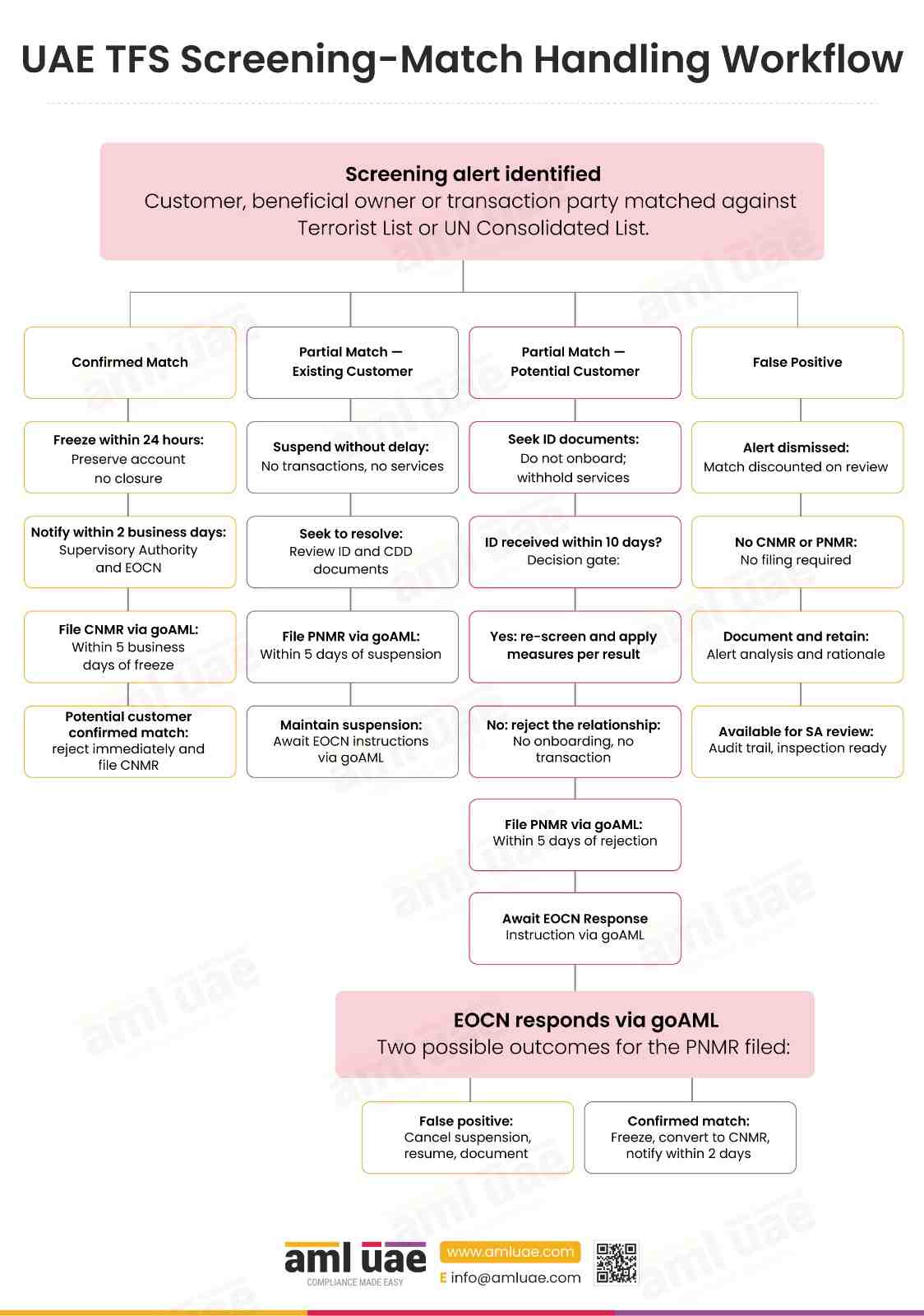
The July 2025 EOCN Guidance distinguishes three reporting workflows that Reporting Entities must operate in parallel when handling Local Terrorist List matches.
Scenario | Required Action |
Confirmed Name Match (CNMR) | A match with the UAE Local Terrorist List is confirmed after reviewing ID and supporting documents. Freeze without delay, reject or terminate any new or attempted relationship, preserve the freeze rather than closing the account (which would not comply with Cabinet Decision No. 74 of 2020), and submit a CNMR through goAML within five business days with all supporting documents. |
Partial Name Match (PNMR) | A potential match with the Local Terrorist List cannot be conclusively confirmed or dismissed. The response depends on the scenario: existing customer, potential customer, or transaction in progress. For existing customers, suspend transactions and seek to resolve the match through ID and CDD documentation. For potential customers, reject the relationship if ID cannot confirm or dismiss the match within 10 business days. For transactions in progress, suspend and seek to resolve. In each scenario, submit a PNMR through goAML within five business days of the applicable trigger and follow the current EOCN PNMR workflow. |
False Positive | On examination, the alert is determined not to be a match. No CNMR or PNMR is required. Reporting Entities should document the screening alert, the analysis performed and the rationale for discounting the match, for audit and supervisory review. |
STR / SAR | A match with any unilateral or multilateral sanctions list outside the scope of Cabinet Decision No. 74 of 2020 (for example OFAC, UKHMT or EU), or suspicious activity that does not trigger a CNMR or PNMR. Consult the Supervisory Authority and file an STR or SAR with the UAE FIU through goAML. |
Reporting Entities must not disclose to the customer or any third party (whether directly or indirectly) that a freezing measure has been applied or that a report has been filed. Tipping-off is a criminal offence under the UAE AML/CFT framework.
Common Mistakes in UAE Local Terrorist List Compliance
Supervisory Authorities and EOCN outreach have highlighted recurring failings in Reporting Entities’ handling of the Local Terrorist List.
- Relying solely on third-party vendor lists without verifying that the vendor list fully reflects the current UAE Local Terrorist List.
- Screening only the customer name and missing connected parties, such as directors, authorised signatories and ultimate beneficial owners.
- Failing to re-screen the entire customer base immediately on receipt of an EOCN list update.
- Closing the account of a designated customer instead of freezing it, which itself breaches Cabinet Decision No. 74 of 2020.
- Tipping off the customer by returning funds, issuing closure notices or notifying them of the freeze.
- Applying only a percentage-based ownership test, missing minority-interest control and ‘acting on behalf of’ triggers.
- Late or inconsistent filing of CNMRs and PNMRs on goAML, including missing or incomplete supporting documents.
- Inadequate weekend and public holiday procedures create gaps where access to funds continues, but screening does not.
Penalties for UAE Local Terrorist List Non-Compliance
Non-compliance with TFS obligations in relation to the UAE Local Terrorist List can attract criminal, administrative and civil consequences. Following the entry into force of Federal Decree-Law No. 10 of 2025 on 14 October 2025, the primary penalty framework for TFS violations now sits within the 2025 AML Law (which repealed Federal Decree-Law No. 20 of 2018 but left Cabinet Decision No. 74 of 2020 in force as the operational TFS instrument).
It is useful to distinguish two tiers of exposure. Tier 1 covers direct penalties for failure to implement TFS obligations. Tier 2 covers wider AML/CFT/CPF exposure that arises where the same facts also amount to terrorist financing, proliferation financing, tipping-off or other criminal offences.
Tier 1: Direct Penalties for Failing to Implement TFS Obligations
Criminal penalty for TFS violations — Article 33 of Federal Decree-Law No. 10 of 2025 provides that any person who violates the instructions issued by the Executive Office or any other Competent Authority related to Targeted Financial Sanctions shall be punished with imprisonment and a fine of not less than AED 20,000, or by either of these two penalties.
Administrative penalties — Article 17 of Federal Decree-Law No. 10 of 2025 empowers Supervisory Authorities to impose a range of administrative penalties on FIs, DNFBPs, VASPs and NPOs for any violation of the Decree-Law, its Executive Regulations or related decisions. The available sanctions are:
- Warning.
- Administrative fine of not less than AED 10,000 and not exceeding AED 5 million per violation.
- Prohibition from engaging in the relevant sector for a period determined by the Supervisory Authority.
- Restriction of the powers of board members, executives, supervisors, managers or owners proven responsible for the violation, including the appointment of a temporary supervisor.
- Suspension, restriction, revocation or cancellation of the business licence.
- Publication of the penalty.
Tier 2: Wider AML/CFT/CPF Exposure
Where the same conduct or surrounding facts also amount to a core criminal offence, significantly higher penalties may apply under the 2025 AML Law or other legislation. These are not automatic consequences of every TFS failure, but they may arise where a Reporting Entity’s conduct crosses into substantive criminality.
- Corporate liability for core offences: Legal persons convicted of money laundering, terrorist financing or proliferation financing face fines of not less than AED 5 million and up to AED 100 million, or an amount equivalent to the value of the criminal property, whichever is greater. Lesser specified offences attract fines of AED 200,000 to AED 10 million.
- Tipping-off: Article 29 of Federal Decree-Law No. 10 of 2025 covers both intentional and grossly negligent acts and introduces aggravated penalties where loss or destruction of criminal proceeds results.
- Underlying terrorist offences: Federal Law No. 7 of 2014 on Combating Terrorism Offences (as amended by Federal Law No. 4 of 2024) imposes substantial penalties, including long-term and life imprisonment, for terrorist offences and the promotion of terrorism.
- No statute of limitations: Article 37 of Federal Decree-Law No. 10 of 2025 removes the limitation period for money laundering, terrorist financing and proliferation financing offences.
Good Faith Protection
The UAE TFS framework protects Reporting Entities that act diligently and in good faith. Any person who, in good faith, freezes funds or other assets, or refuses to provide financial services to designated individuals, entities or groups in compliance with Cabinet Decision No. 74 of 2020, is exempt from damages or claims, including criminal, civil and administrative liability. This applies even where the freezing measure later turns out to have involved a false positive. The protection is important because it removes the legal risk that might otherwise discourage institutions from acting quickly and decisively on Local Terrorist List matches.
Wider Commercial Consequences
- Loss of correspondent banking relationships, especially for financial institutions, can impede cross-border transactions.
- Reputational damage that can outlast any regulatory penalty and affect customer acquisition, funding and counterparty relationships.
- Enhanced regulatory scrutiny and follow-up inspections by the Supervisory Authority and the EOCN.
How AML UAE Helps with Local Terrorist List Compliance
AML UAE helps financial institutions, DNFBPs and VASPs build a sanctions compliance programme that treats the UAE Local Terrorist List as a primary screening priority, alongside the UN Consolidated List. Our support covers:
- Sanctions screening framework: Designing and tuning name-screening and transaction-screening controls for the Local Terrorist List and other applicable lists, including ownership, control and ‘acting on behalf of’ analysis.
- EOCN and goAML registration: Supporting registration with the Notification Alert System and goAML, and configuring internal alerting workflows.
- Policies and playbooks: Drafting TFS policies, procedures and match-handling playbooks aligned with Cabinet Decision No. 74 of 2020, the 2025 AML/CFT framework and the July 2025 EOCN Guidance.
- Staff training: Delivering role-based training on Local Terrorist List screening, match handling, tipping-off avoidance, and CNMR, PNMR and STR/SAR workflows.
- Independent reviews and audit readiness: Reviewing the effectiveness of existing sanctions programmes, preparing documentation for supervisory inspection, and advising on remediation of control gaps.
FAQs on the UAE Local Terrorist List
The UAE Local Terrorist List is the national list of designated terrorist individuals, entities and groups, issued by the UAE Cabinet on the proposal of the Supreme Council for National Security under UNSCR 1373 (2001), Federal Law No. 7 of 2014 and Cabinet Decision No. 74 of 2020. It is distinct from the UN Consolidated List, but both are part of the UAE TFS framework and must be implemented by Reporting Entities.
The UAE Cabinet issues the Local Terrorist List on the proposal of the Supreme Council for National Security. The Executive Office for Control and Non-Proliferation (EOCN) publishes the list on its website and circulates updates through its Notification Alert System.
The current Local Terrorist List is available on the EOCN website (in PDF and Excel formats) and via the Notification Alert System. Reporting Entities must register with the NAS to receive automated email updates whenever the list changes.
The UN Consolidated List is compiled by UNSC Sanctions Committees under Chapter VII UNSCRs (such as 1267, 1988 and 1718) and applies globally. The UAE Local Terrorist List is a domestic list issued by the UAE Cabinet under UNSCR 1373 and applies within the UAE framework. Reporting Entities must screen against both.
Screening must be ongoing and risk-based. This includes daily list checks, onboarding screening, transaction screening, periodic KYC review, and immediate re-screening whenever the list is updated. Screening procedures must continue on weekends and public holidays where access to funds remains possible.
On a confirmed match, the Reporting Entity must freeze funds and prohibit the provision of services without delay (within 24 hours of designation), preserve the freeze rather than closing the account, notify the Supervisory Authority and the Executive Office within two business days, and file a CNMR through goAML within five business days. For a partial match, the response depends on whether it concerns an existing customer, potential customer or transaction in progress; in each case, the Reporting Entity should follow the current EOCN PNMR workflow and submit a PNMR through goAML within five business days of the relevant suspension or rejection event.
Yes. The Supreme Council for National Security conducts periodic reviews of the Local Terrorist List and, if it considers that the designation criteria are no longer met, proposes de-listing. De-listing takes effect only once the UAE Cabinet approves the proposal. Listed persons and affected third parties may also submit grievances to the Executive Office.
A listed person or their legal representative may submit a written application to the Executive Office for permission to use part of the frozen funds for necessary or basic expenses (food, rent, mortgage, medicine, medical treatment, insurance, education, legal and judicial fees, and public utility fees), subject to Ministry of Justice approval and Supreme Council coordination.
Yes. Virtual Asset Service Providers are Reporting Entities under Cabinet Decision No. 74 of 2020 and the 2025 AML/CFT framework, and must screen against the UAE Local Terrorist List and the UN Consolidated List, freeze without delay and file CNMRs or PNMRs through goAML.
Under Article 33 of Federal Decree-Law No. 10 of 2025, any person who violates the instructions of the Executive Office or other Competent Authority on Targeted Financial Sanctions is liable to imprisonment and a fine of not less than AED 20,000, or either penalty. Article 17 of the same Decree-Law empowers Supervisory Authorities to impose administrative penalties ranging from warnings to fines of AED 10,000 to AED 5 million per violation, prohibition from the sector, restriction of powers of responsible persons, and cancellation of the business licence. Legal persons convicted of core AML/CFT/CPF offences face fines of up to AED 100 million or the value of the criminal property, whichever is greater. Federal Law No. 7 of 2014 (as amended by Federal Law No. 4 of 2024) applies separately to underlying terrorist offences.
Yes. The UAE TFS framework expressly protects persons who act in good faith. Any person who, in good faith, freezes funds or refuses to provide financial services to designated individuals, entities or groups in compliance with Cabinet Decision No. 74 of 2020 is exempt from damages or claims, including criminal, civil and administrative liability. This protection applies even where the freezing measure later turns out to have involved a false positive. Where a similarly-named person is adversely affected, that person may apply to the Executive Office for de-freezing.
Yes, in limited circumstances. The EOCN confirms that frozen accounts may be credited with interest, profits or other earnings due on the account, and with payments due under contracts, agreements or obligations concluded or arising before the date on which the individual or legal entity was designated. Any such additions must themselves be immediately frozen, and the relevant Supervisory Authority and the Executive Office must be notified. This allows institutions to comply with the freezing regime without breaching pre-existing contractual obligations to third parties.
No. CBUAE guidance is clear that external screening tools are useful but should not be viewed as an absolute guarantee of compliance. Reporting Entities must undertake due diligence on vendors and ensure that vendor lists fully reflect the current UAE Local Terrorist List and UN Consolidated List as published by the EOCN and the UNSC. Registration on the EOCN Notification Alert System (NAS) is required to receive timely updates directly from the source, and the official EOCN and UNSC publications take precedence over any vendor list in the event of a discrepancy.
Strengthen Your UAE Local Terrorist List Compliance with AML UAE
Local Terrorist List compliance is not an occasional check. It requires continuous screening, disciplined match handling, timely reporting through goAML and clear governance from the board down. AML UAE partners with financial institutions, DNFBPs and VASPs to build sanctions programmes that are defensible before supervisors and resilient in daily operations.
To discuss your UAE Local Terrorist List screening and TFS arrangements, contact AML UAE at [email protected].
Disclaimer : This article provides general information on the UAE Local Terrorist List and the related AML/CFT framework. It does not constitute legal advice. Regulated entities should consult their Supervisory Authority and qualified advisers in relation to their specific obligations under Cabinet Decision No. 74 of 2020, Federal Law No. 7 of 2014 (as amended), Federal Decree-Law No. 10 of 2025, Cabinet Resolution No. 134 of 2025, and the current EOCN Guidance on Targeted Financial Sanctions.
Build a Robust AML Compliance Program
We provide customised AML/CFT Policies and Procedures that are compliant with UAE Laws
Share via :
About the Author

Pathik Shah
FCA, CAMS, CISA, CS, DISA (ICAI), FAFP (ICAI)
Pathik is an ACAMS-certified AML consultant specialising in governance, risk, and compliance for regulated entities in the UAE. He brings over 28 years of experience, with 1,000+ hours of AML training and 200+ advisory engagements across DNFBPs, VASPs, and FIs. He supports businesses in aligning with AML/CFT requirements from the CBUAE, DFSA, MoET, MoJ, VARA, CMA, FSRA, and FATF. Known for translating complex regulations into audit-ready procedures, Pathik enables operational clarity and compliance readiness.

Reach Out to Pathik